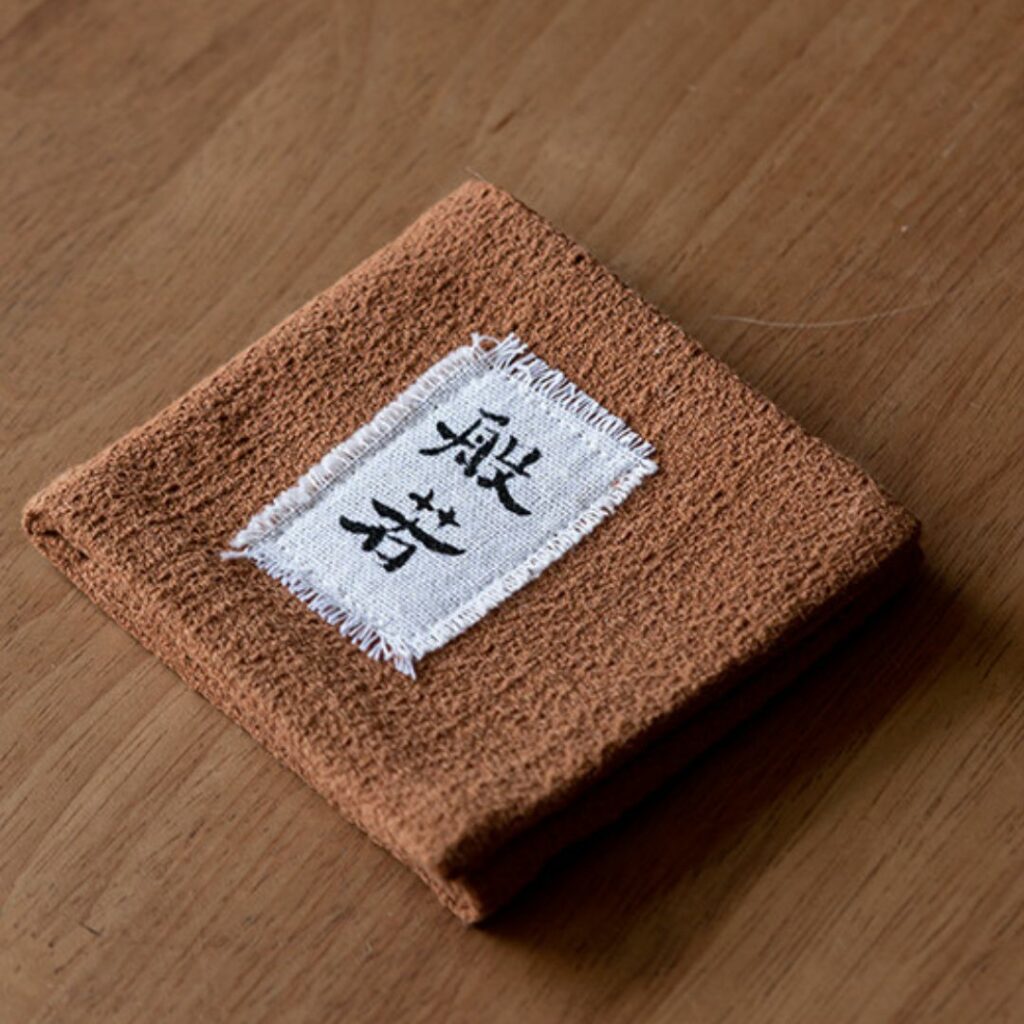
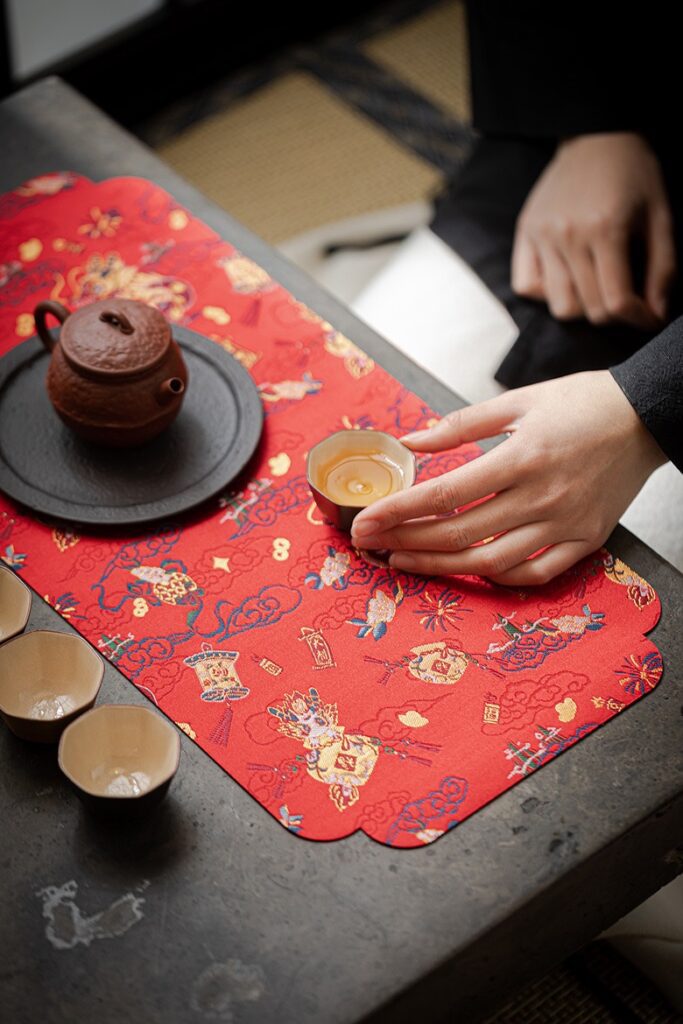
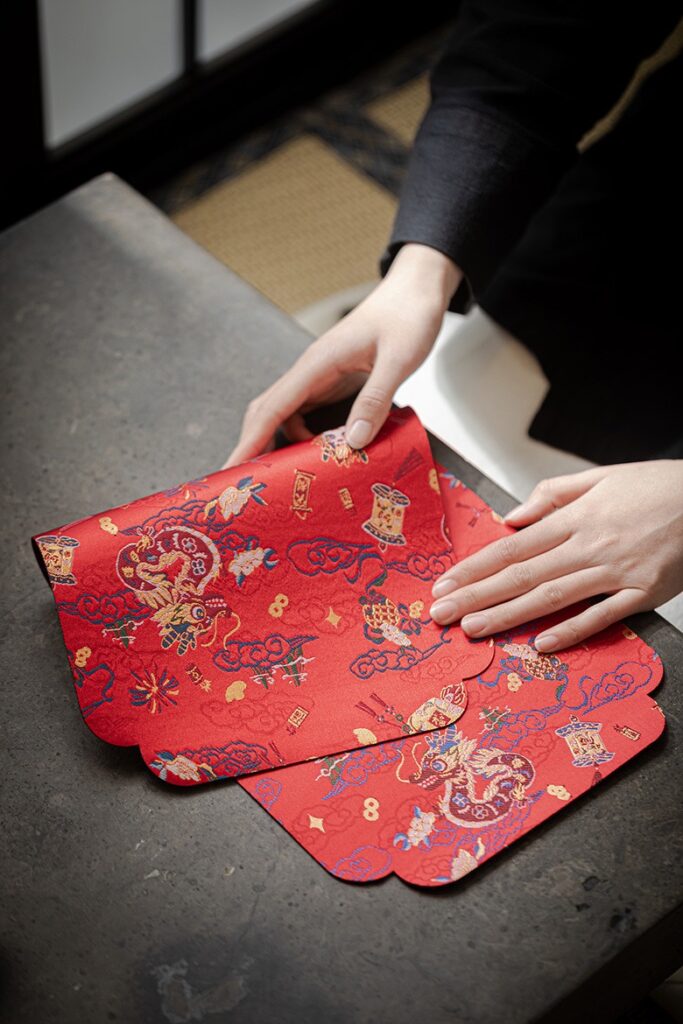
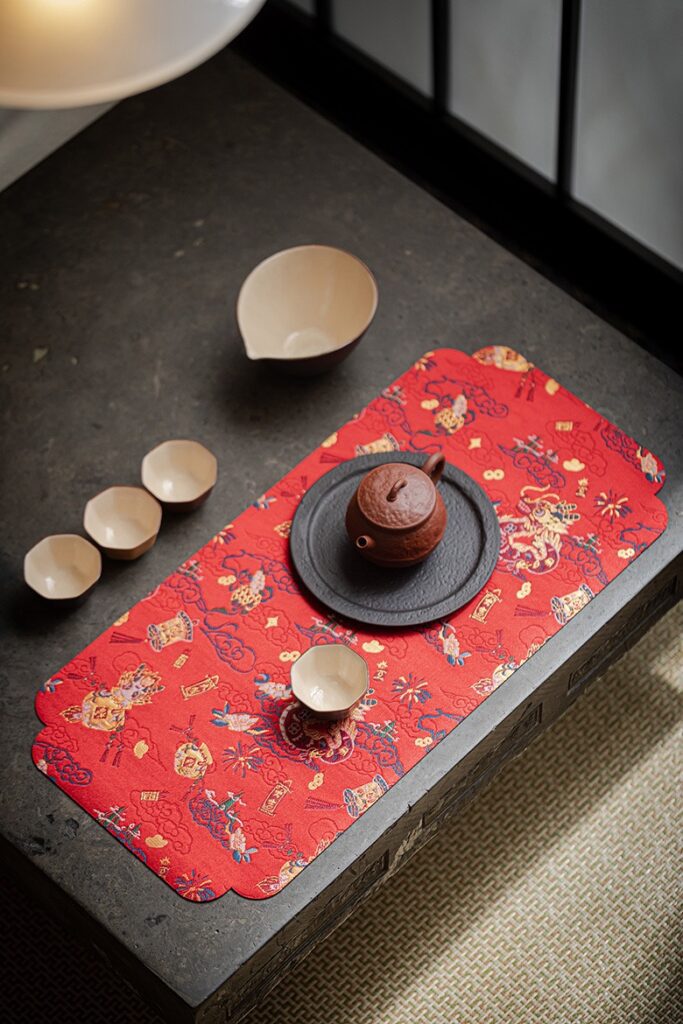
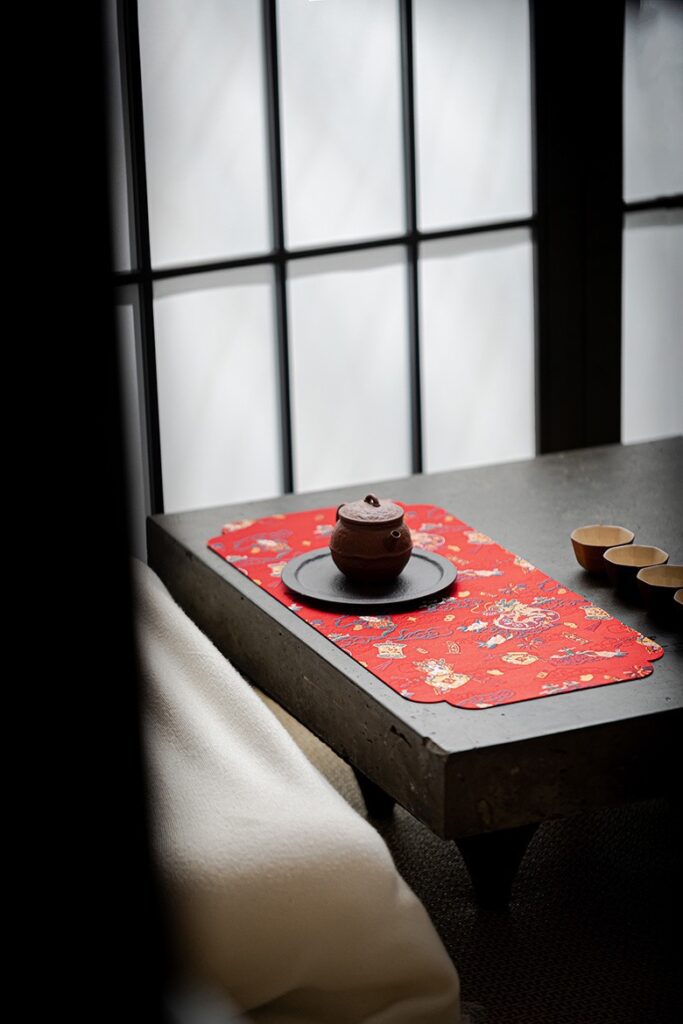
차 애호가 여러분, 안녕하세요! 🐉✨ 2024년 용의 해를 맞이하여 흥미로운 소식을 전해 드립니다. 이싱 찻주전자를 구매하시는 분들께는, 차 마시는 시간을 한층 더 특별하게 만들어 줄 용의 해 한정판 차 매트를 선물로 드립니다. 여러분과 함께 새해를 축하하는 저희만의 방식입니다. 단, 이 혜택은 기간 한정으로 제공되니 꼭 기억해 주세요! 이 신비로운 아이템으로 여러분의 차 시간을 더욱 특별하게 만들어 보세요. 🍵💫
If you first met Pixiu through a bracelet, a Feng Shui shop or a small ornament beside a cash register, you were probably given a very simple explanation:
Pixiu attracts wealth.
That is certainly how the creature is understood today. But it is not where the story begins.
Long before Pixiu became a familiar symbol of money and prosperity, Chinese art already had a family of fierce, winged guardian beasts. They stood at tombs, appeared in elite decorative objects and carried a much broader idea: protection.
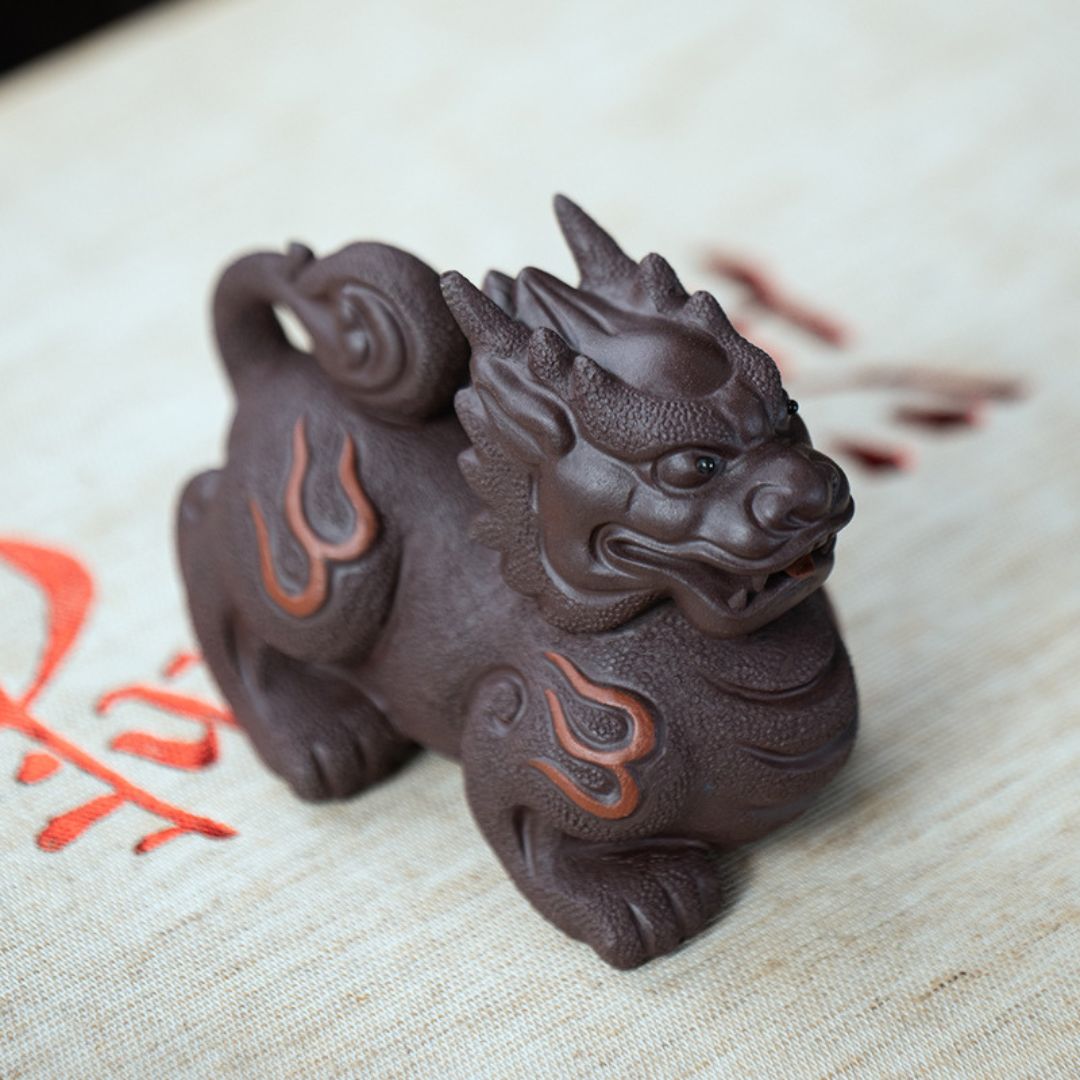
So what exactly is Pixiu, and how did an ancient guardian beast become one of the most recognizable wealth symbols in Chinese culture?
There is no single design that every Pixiu has to follow.
Across Chinese art, the creature belongs to a broad family of hybrid beasts. It may have a lion-like body, a powerful open mouth, horns, wings, hooves or clawed feet, and features that feel partly dragon-like.
That sounds imprecise, but it reflects the history of the image better than a modern character sheet would.
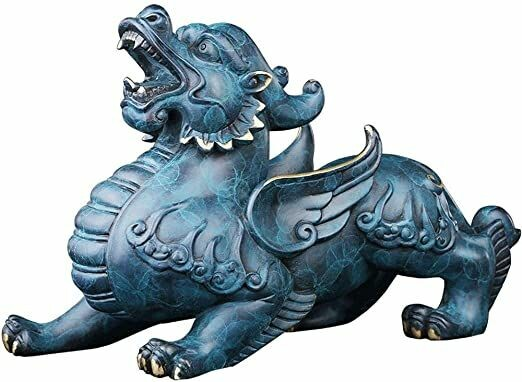
Historical examples vary. One horn or two may appear. Wings can be prominent or barely suggested. Some figures look close to lions; others feel much more fantastical.
The important thing is the overall character: Pixiu is not a gentle animal. It is a strong, alert, guardian-like beast.
This is the part that tends to disappear from modern introductions.
그 National Museum of Natural Science in Taiwan describes Pixiu as a tomb guardian beast. Its Chinese-language research on related bixie figures explains that lion-faced, winged mythical animals—including forms called Bixie, Tianlu and Pixiu—belonged to a larger family of protective creatures used around tombs and elite ritual settings.
그 National Museum of History identifies this Western Han bronze Bixie as part of the same tradition surrounding names such as Pixiu and Tianlu. The creature is described as a fierce auspicious beast with protective meaning.
That older role is important.
Pixiu was not originally interesting because it promised to make someone rich. It was interesting because it was powerful enough to stand between people and danger.
If you try to research Pixiu through museum collections, the naming quickly becomes messy.
You will run into 픽시우, Bixie 그리고 Tianlu, sometimes treated as distinct creatures and sometimes grouped together.
그 National Palace Museum notes that Bixie and Pixiu have at times been regarded as the same mythical beast. Historical traditions also tried to distinguish related figures through details such as the number of horns, but those rules were not followed consistently enough to work as a universal identification system today.
So if two old winged beasts look almost identical but one museum calls one Bixie and another source calls a similar form Pixiu, that does not necessarily mean somebody made a mistake.
It may simply reflect how fluid Chinese mythical-animal imagery has always been.
This is where the older guardian identity begins to overlap with later ideas of prosperity.
Today Pixiu is strongly associated with attracting and protecting wealth. It appears in jewelry, office ornaments, home decoration and Feng Shui objects, often facing outward as if searching for valuable things to bring back.
The wealth association is now a genuine part of the creature’s cultural identity. But it should not be projected unchanged all the way back onto every ancient winged beast.
The older material record emphasizes auspiciousness, power and guardianship. The very specific modern image of Pixiu as a creature whose main job is collecting money developed later.
The Palace Museum still presents Pixiu as an auspicious guardian image associated with protection and good fortune, while modern decorative culture has pushed the prosperity side much further.
This is probably the best-known Pixiu legend today.
According to later folklore, Pixiu loves gold, silver and treasure but has no way to expel what it eats. Wealth can enter, but it cannot leave.
It is a wonderfully memorable explanation for the modern idea of wealth accumulation.
It is also better treated as later folklore, not as the documented ancient origin of Pixiu.
Older museum objects and descriptions of winged guardian beasts do not depend on that story. Their symbolism centers much more clearly on protection, auspicious power and the ability to ward off harmful forces.
That does not make the later legend meaningless. Folk traditions keep evolving. It simply means we should not make a newer story carry the entire weight of a much older creature.

Chinese mythical animals borrow visual features from one another so freely that confusion is almost unavoidable.
Pixiu can look lion-like. So can 수아니. Qilin may also combine horns, scales and features from several animals. Guardian lions add another layer of overlap.
There is no perfect checklist, but context helps.
Pixiu is usually the more forceful guardian type and, in modern use, the one most strongly associated with wealth. Suanni has a different history built around lion imagery and later smoke-and-incense associations. Qilin belongs to another auspicious tradition entirely.
The differences are cultural, not zoological.
A creature designed to look alert and protective adapts surprisingly well to a tea table.
In large stone or bronze form, a winged guardian beast can feel imposing.
Scale it down into clay and something changes.
The same wide mouth, strong paws and watchful expression can become compact, tactile and even a little playful. Pouring tea over an unglazed clay Pixiu gradually changes the surface, so the object develops along with the tea practice around it.
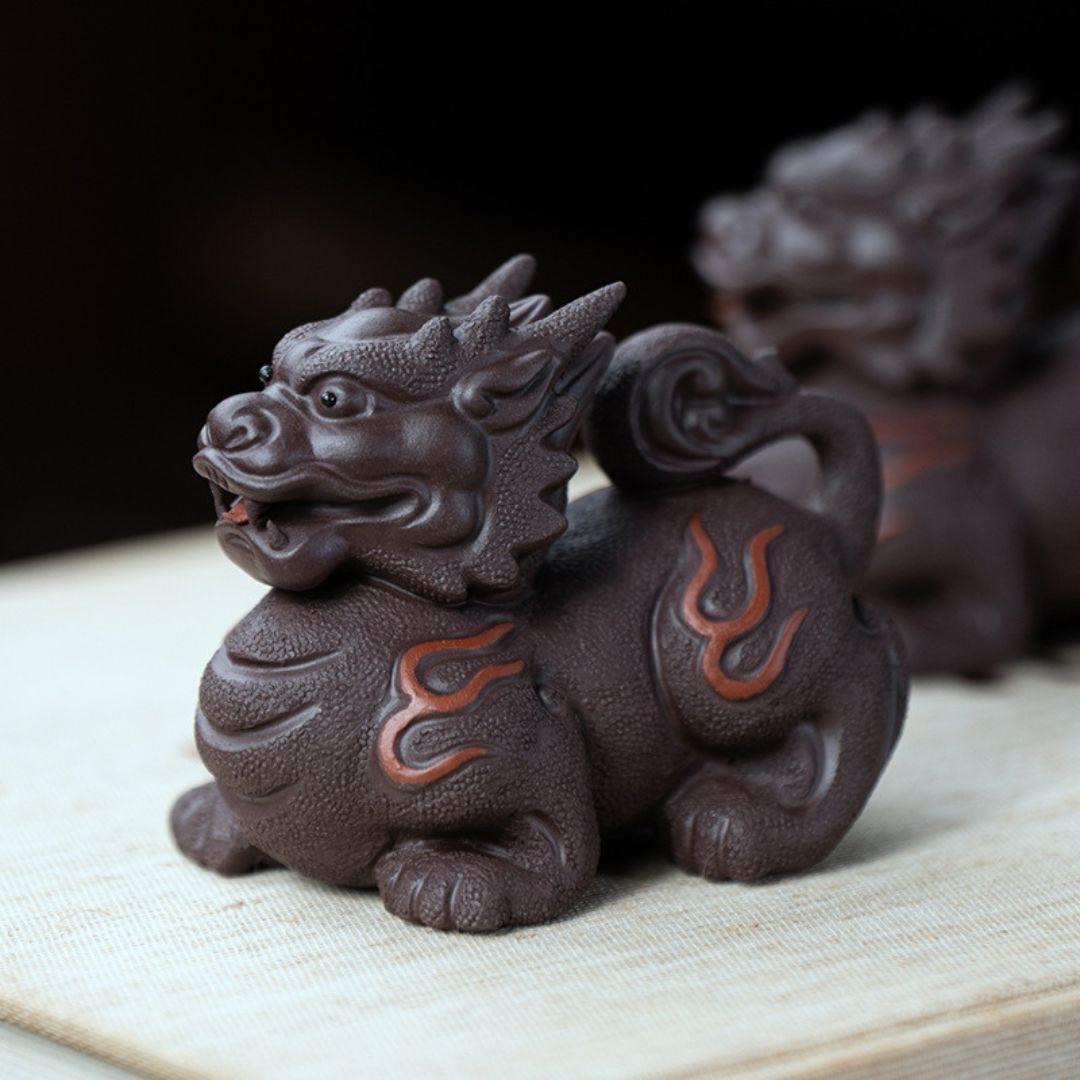
저희 Zini clay Pixiu tea pet is one contemporary version of that idea.
You can enjoy the wealth symbolism if it means something to you. But the creature does not need a supernatural promise to be interesting.
Its older identity—as a fierce, auspicious guardian—is already enough.
Modern Pixiu is easy to summarize:
A mythical beast that attracts wealth and keeps it from leaving.
That sentence explains why Pixiu appears on so many bracelets, ornaments and tea pets today.
But it misses the creature standing behind it.
Before Pixiu guarded money, winged beasts guarded tombs.
Before people worried about which direction a small statue should face, much larger creatures stood watch over spaces associated with power, death and protection.
And before the popular story about treasure going in and never coming out, Pixiu already belonged to an old Chinese visual language of fierce auspicious guardians.
The wealth symbolism did not erase that history.
It became another layer of it.
To explore more of these creatures, see our guide to 중국 신화 속 괴물들, our article on 수아니, and the story of Jin Chan, the three-legged Money Frog.