Przerwa w wysyłkach świątecznych — wznowienie 8 października. Świętuj Święto Środka Jesieni, korzystając z rabatu 10% po wpisaniu kodu ctsmooncake. OdrzućPrzejdź do treści
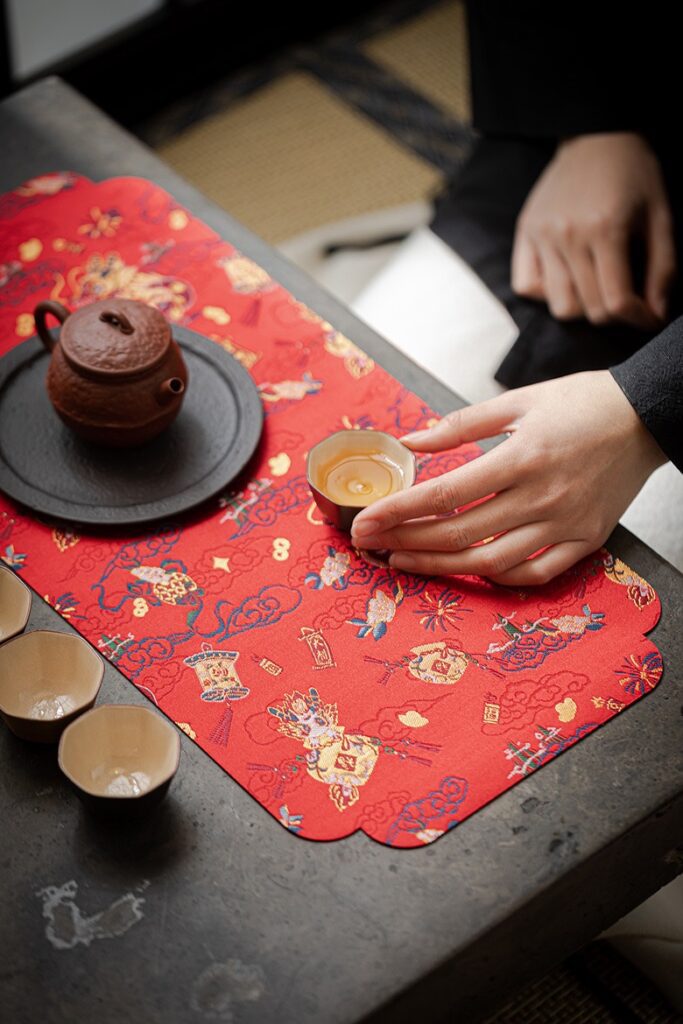
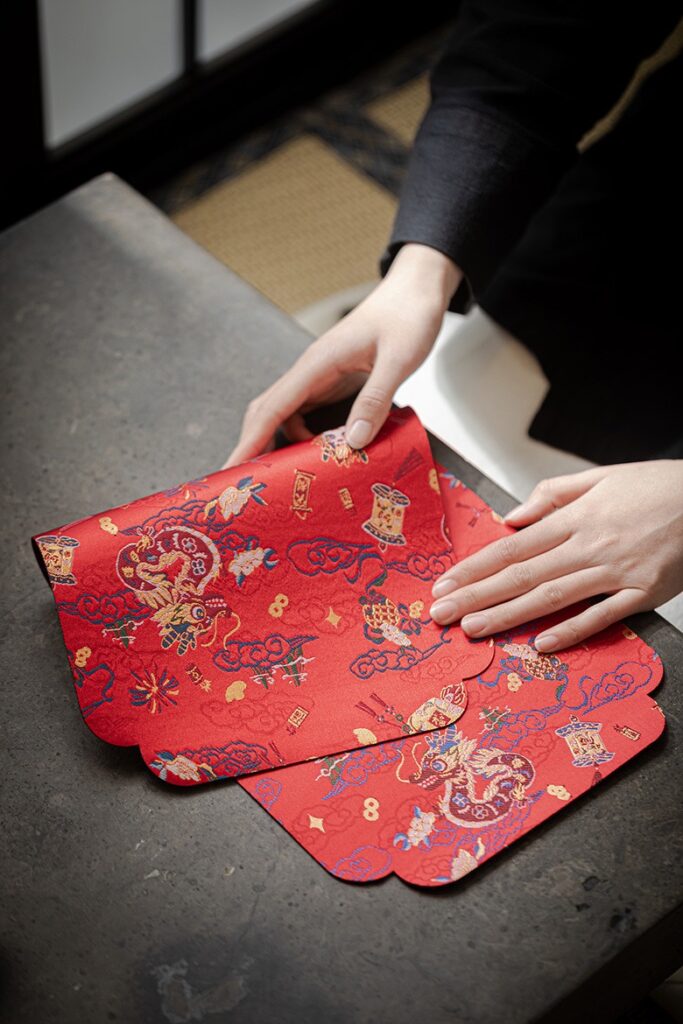
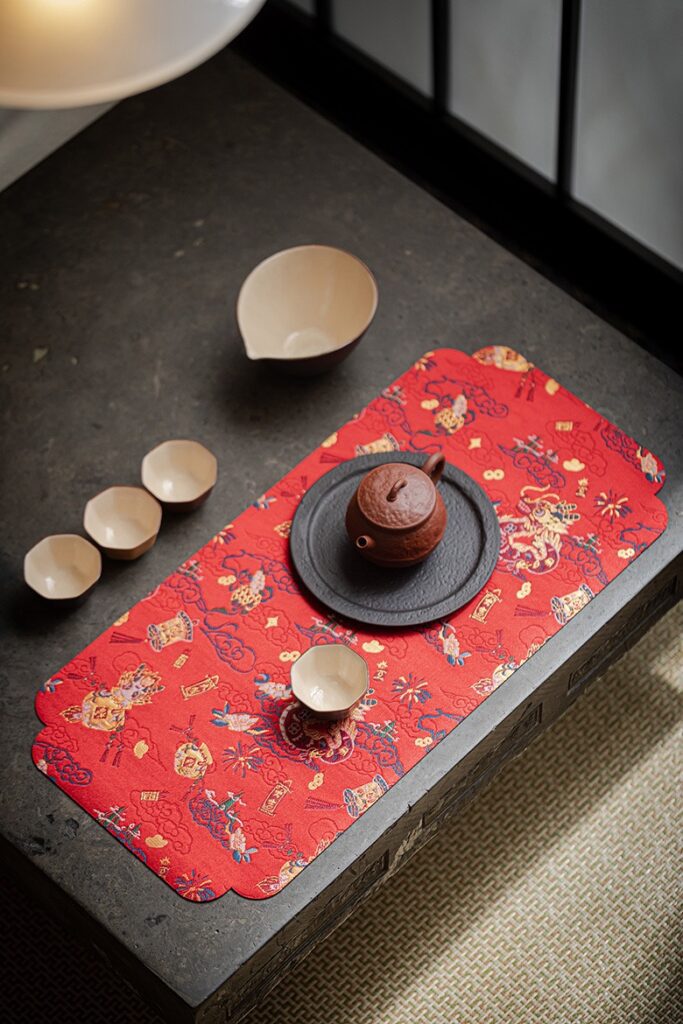
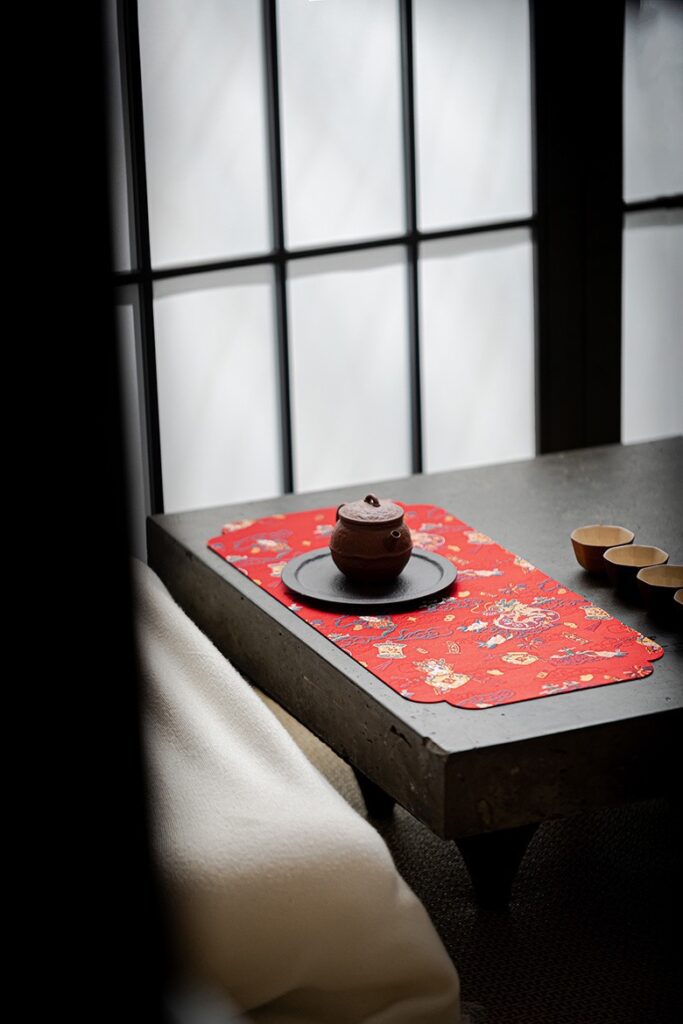
Hej, miłośnicy herbaty! 🐉✨ Mamy ekscytującą wiadomość na początek Roku Smoka 2024 – przy zakupie czajniczka Yixing otrzymacie w prezencie ekskluzywną podkładkę pod czajniczek w stylu Roku Smoka, która doda Waszym rytuałom parzenia herbaty wyjątkowego uroku. To nasz sposób na świętowanie razem z Wami, ale pamiętajcie, że jest to oferta ograniczona czasowo! Nie przegapcie okazji, by dzięki temu mistycznemu dodatku uczynić Wasze sesje herbaciane jeszcze bardziej wyjątkowymi. 🍵💫
Witajcie, miłośnicy herbaty! Chociaż wielu z was zna nas jako firmę oferującą wysokiej jakości chińskie akcesoria do parzenia herbaty, Specjalizujemy się również w herbatach z regionu Huang Shan. Huang Shan to ojczyzna najsłynniejszych chińskich herbat – Huang Shan Mao Feng, Keemun i Tai Ping Hou Kui. Jako mieszkańcy tego zapierającego dech w piersiach miejsca, jesteśmy głęboko związani z tą ziemią i jej bogatym dziedzictwem herbacianym.
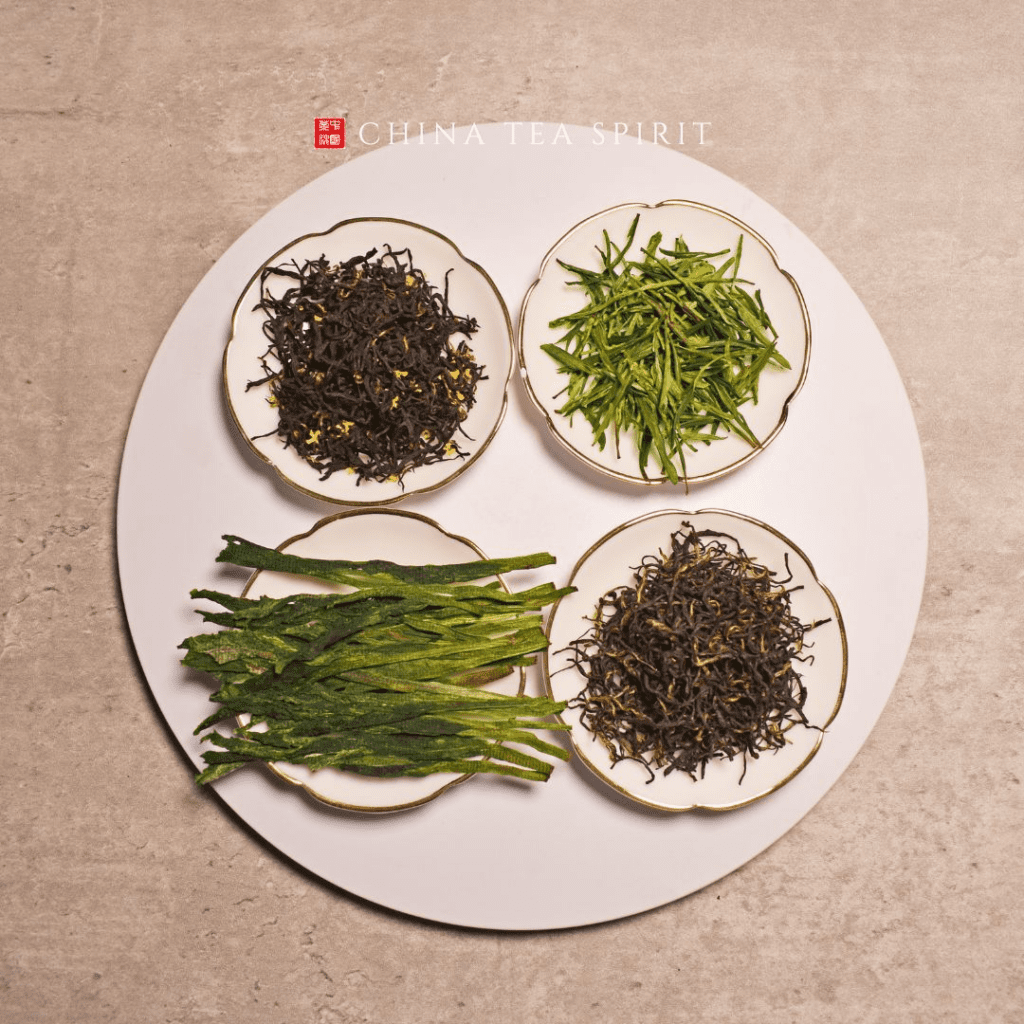
Rozumiemy, że znalezienie idealnej herbaty może być osobistą podróżą, dlatego oferujemy nasz zestaw próbek. Dzięki niemu możesz poznać różnorodne smaki herbat Huang Shan i odkryć tę, która najbardziej przypadnie Ci do gustu.
Każda z tych herbat pochodzi bezpośrednio od plantatorów herbaty i jest przez nich produkowana, co gwarantuje jej jakość i autentyczny smak.
Zestaw próbek zawierający: Huang Shan Mao Feng – 10 g Tai Ping Hou Kui – 10 g Keemun Mao Feng – 10 g Osmanthus Keemun – 10 g
Z niecierpliwością czekamy na Wasze opinie na temat naszych herbat. Dołączcie do nas w tej podróży i pozwólcie nam być Waszym przewodnikiem podczas odkrywania czarującego świata herbat z Huang Shan.
Należy pamiętać, że herbata i akcesoria do parzenia herbaty zostaną wysłane w oddzielnych paczkach zgodnie z wymogami celnymi. Zazwyczaj herbata dociera nieco później niż akcesoria do parzenia herbaty.
Drodzy klienci,
Jeśli podczas realizacji zamówienia wystąpiły jakiekolwiek problemy, prosimy o kontakt pod adresem [email protected]. A my Ci w tym pomożemy.
Poniżej przedstawiamy listę typowych błędów związanych z płatnościami oraz sposoby ich rozwiązania, które mogą Państwu pomóc.
#1: Firma China Tea Spirit nie realizuje wysyłek do tej lokalizacji. Prosimy o podanie innego adresu.
Jest to znany błąd serwisu PayPal. Występuje on losowo. Jeśli pojawił się u Ciebie ten komunikat o błędzie, skontaktuj się z nami pod adresem [email protected]. Zajmiemy się tym za Ciebie.
In a familiar pair of Chinese guardian lions, one animal rests a paw on a patterned ball. Beside the other is a small cub. Both may have curled manes, broad mouths and wonderfully theatrical expressions, but those little details tell you they are not simply two copies of the same sculpture.
They are also not dogs. Despite the English names Foo Dogs oraz Fu Dogs, these figures belong to the tradition of Chinese guardian lions.
Once you notice the ball, the cub and the stance, a figure that initially seemed like a strange decorative animal becomes much easier to read. The expression is only the beginning.
A dog in the name, a lion in the design
Foo dog, fu dog oraz lion dog are English names used for these stylized lions. In Chinese, shizi means lion; shishi refers to stone lions. The English nickname is not a literal translation of either term.
It is worth separating that naming habit from the object itself. A figure sold as a Foo Dog is not necessarily depicting a particular breed of dog. For identifying the artistic tradition, Chinese guardian lion is the clearer description. Even museum catalogues can preserve both names: the Penn Museum’s record of a Qing cloisonne lion lists Fu Lion and Fu Dog together, while describing the animal as a lion.
The face can still look surprisingly dog-like. That is understandable when you look at the rounded muzzle, close-set curls and compact body. But resemblance is not the same as identity.
Why the lion became something distinctly Chinese
Ten Muzeum Sztuki Metropolitalnej notes that lions were not native to China, although some had arrived from the west by the Western Han period. As Buddhism became firmly established, the lion also acquired a powerful role as a defender of the faith and Buddhist law.
That history helps explain why a Chinese lion can communicate much more than animal strength. It belongs to an artistic world of guardianship, sacred settings and authority.
Incense burner with lions, China, second half of the sixth century. Glazed earthenware. The Metropolitan Museum of Art, Fletcher Fund, 1927, accession 27.46. Public Domain.
Look at the lions supporting this sixth-century vessel. They do not resemble the gilded palace pair above, yet their crouched bodies and animated faces have an unmistakable presence. The example also shows that lions were appearing on small objects, not only at gateways.
On the palace lions, curls become almost architectural. Claws, teeth and eyes are enlarged into features you can read from a distance. You do not need to mistake the sculpture for a living animal to understand that it is watching the entrance.
The ball and the cub are better clues than the mane
In the familiar paired arrangement, the lion with the ball is the male, while the one with a cub is the female. The Penn Museum identifies its female lion by the cub beneath her feet. A mane alone is not a reliable way to tell them apart in this stylized tradition.
Notice how much the cub changes the mood. The adult may still look imposing, but the smaller animal introduces a scene of contact and play. The ball does something similar: it gives the raised paw a purpose.
For a collector, these details are more useful than trying to decide whether one face looks sufficiently fierce or whether a mane has the right number of curls. They are also reasons to ask for a complete photograph rather than a close-up of the head.
Treat this as a familiar convention, not a test that every Chinese lion in every medium must pass. A small ceramic interpretation may simplify the whole composition, leave out the companion or replace the accessory with something else.
Not every lion-like beast is Suanni
This is where a little context helps more than a longer list of horns and claws.
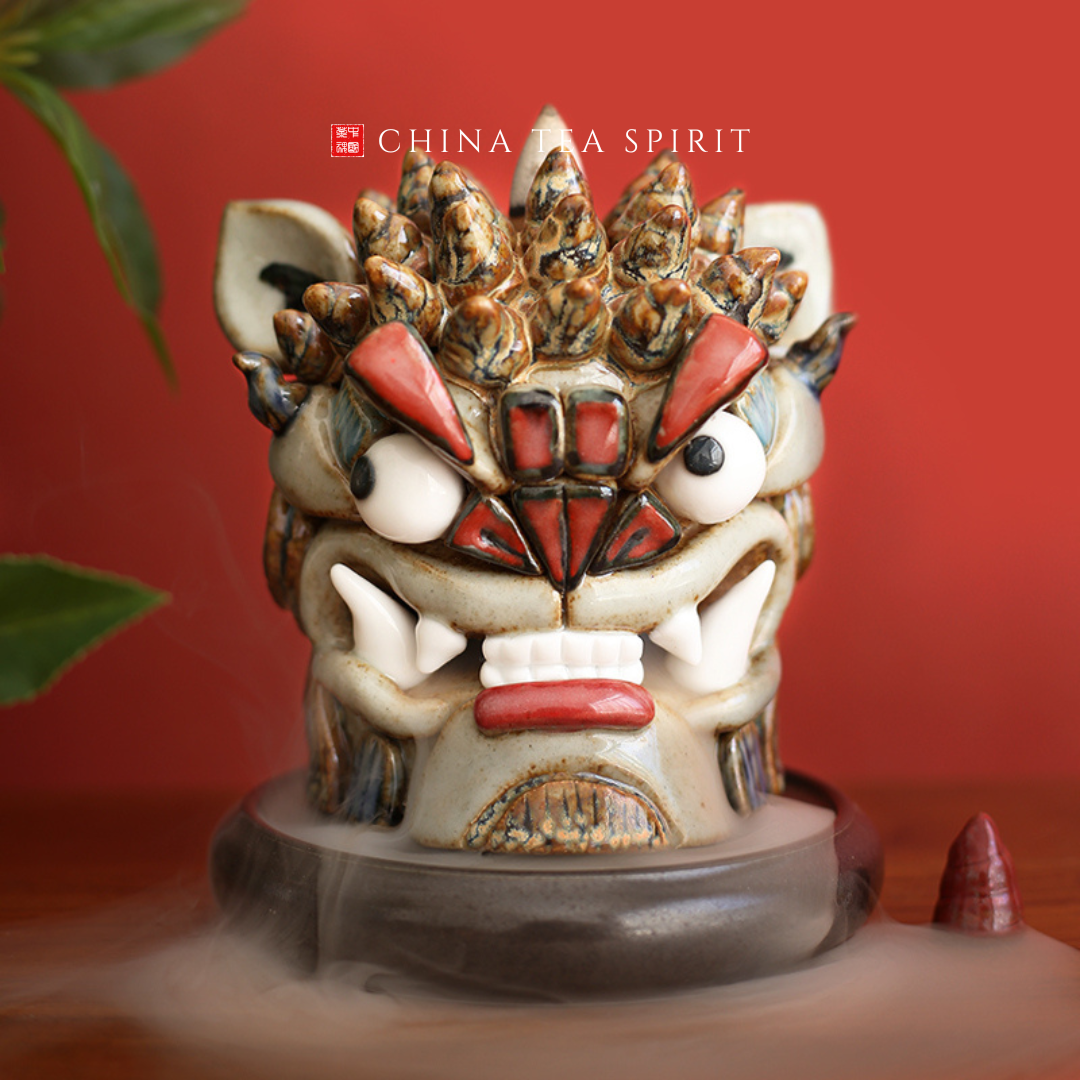
Guardian lion is a useful name for the protective lion tradition, especially the paired figures at entrances. Suanni has an overlapping lion-related history, but later stories give it a place among the Dragon’s sons and associate it with quiet sitting and smoke. The Opis „Dziewięciu Synów” autorstwa Muzeum Pałacowego describes that incense-related role.
A contemporary Suanni from China Tea Spirit. Similar lion-like features do not make every sculpted beast the same creature.
The traditions can share a face without sharing every story. A maker’s description, the setting and the way an object functions are all worth considering before assigning a name.
The same caution applies to Pixiu. A broad mouth and a forceful expression do not automatically turn a lion into the wealth-associated mythical beast.
Small guardians are not a new invention
It is tempting to imagine a simple journey from enormous palace sculpture to tiny modern ornament. Surviving objects make that story less tidy.
That does not make today’s ceramic tea pets ancient objects. It does show how comfortably the lion can work at different scales. A large guardian commands a doorway. A small one invites a closer look.
When a guardian becomes a tea-table companion
The shift in scale changes the relationship. The face that would look formidable above a flight of steps can feel almost mischievous beside a gaiwan.
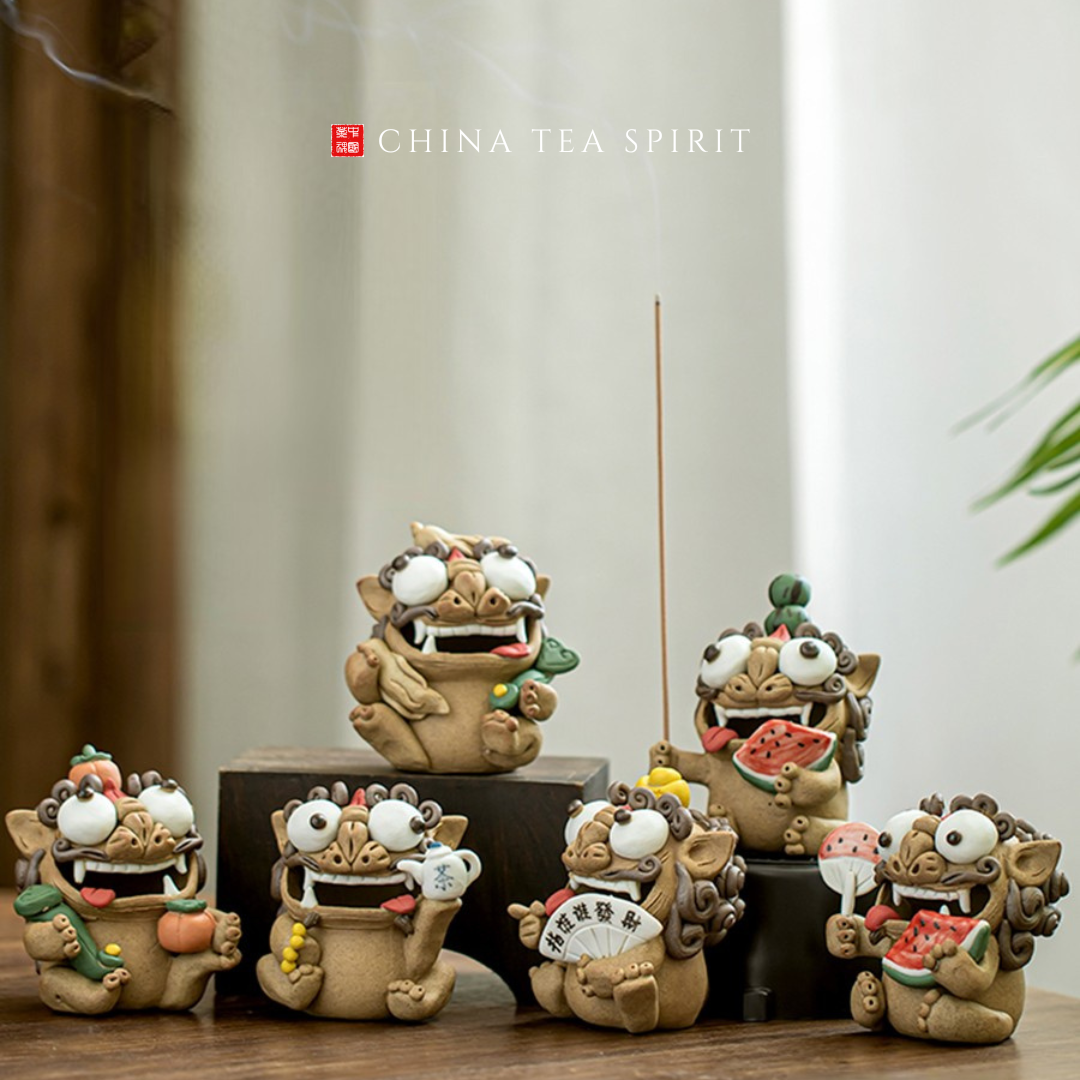
Nasza Foo Dog tea pet is a contemporary handmade Jingdezhen ceramic interpretation. It belongs to this more playful end of the lion tradition, rather than reproducing one particular historic palace statue.
A modern ceramic lion tea pet from China Tea Spirit. An old subject can take on a much more personal character.
A single figure can be enjoyed as a sculpture without pretending it is a complete ceremonial pair. When choosing one, look at the actual piece: its proportions, its expression and the details that make you want to keep noticing it.
The appeal need not depend on a promise that it will change your fortune. A small guardian can mark a space as yours simply by becoming a familiar part of it.
The next time you meet one of these creatures, start at the paws. Then look at the face again. A ball, a cub or a carefully chosen accessory can turn a generic “Foo Dog” into a much more particular object—and a much better story.