Versandpause während der Feiertage – Wiederaufnahme am 8. Oktober. Feiern Sie das Mittherbstfest mit 10% Rabatt unter Verwendung des Codes „ctsmooncake“. SchließenZum Inhalt springen
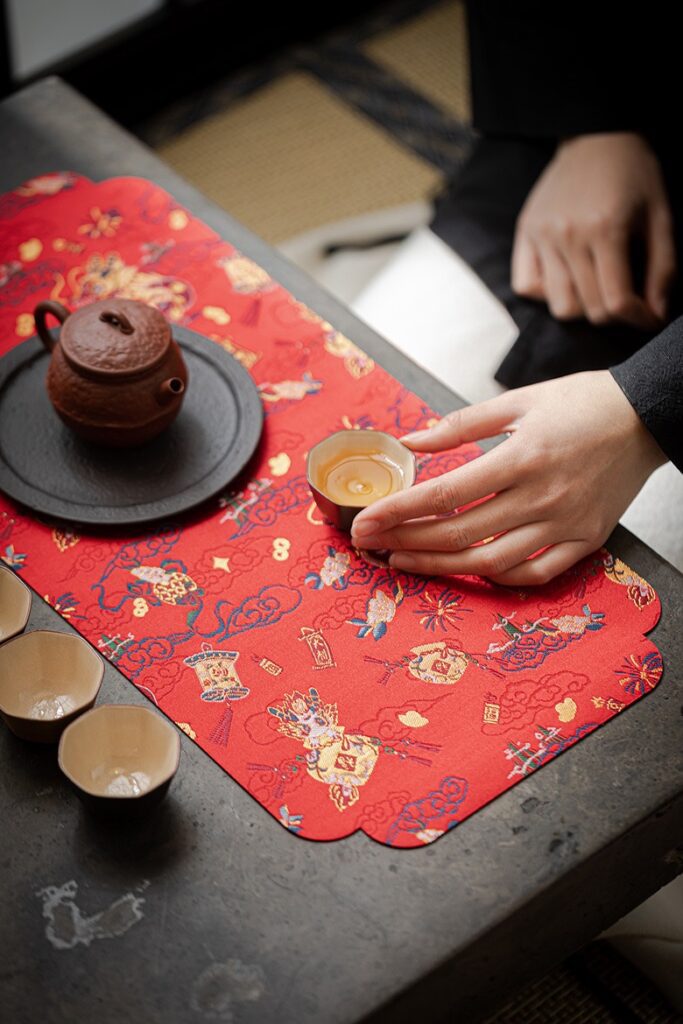
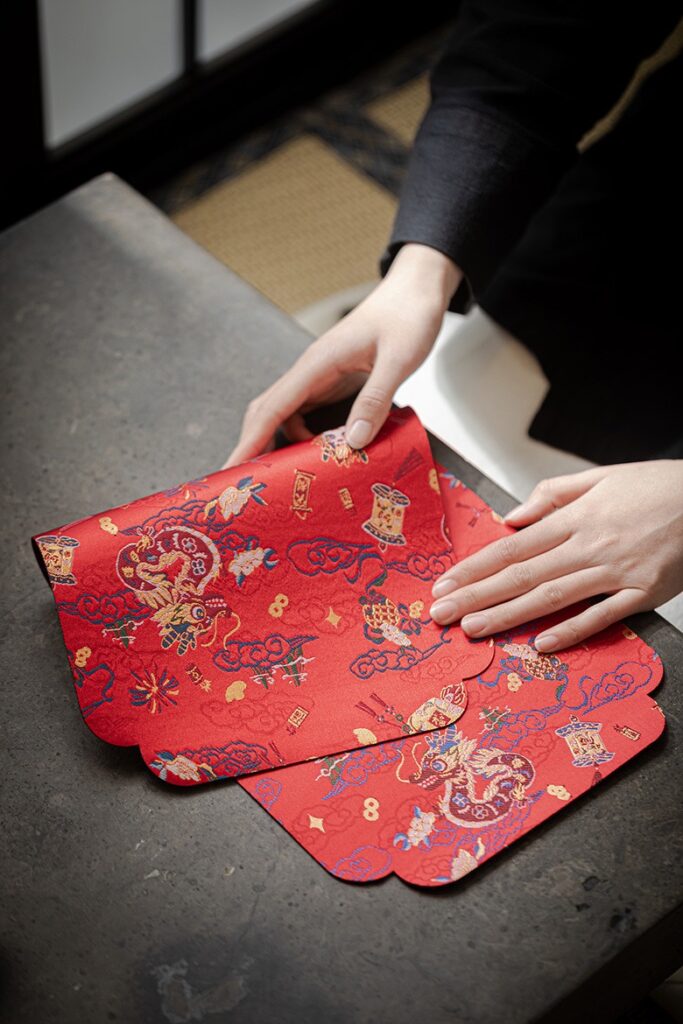
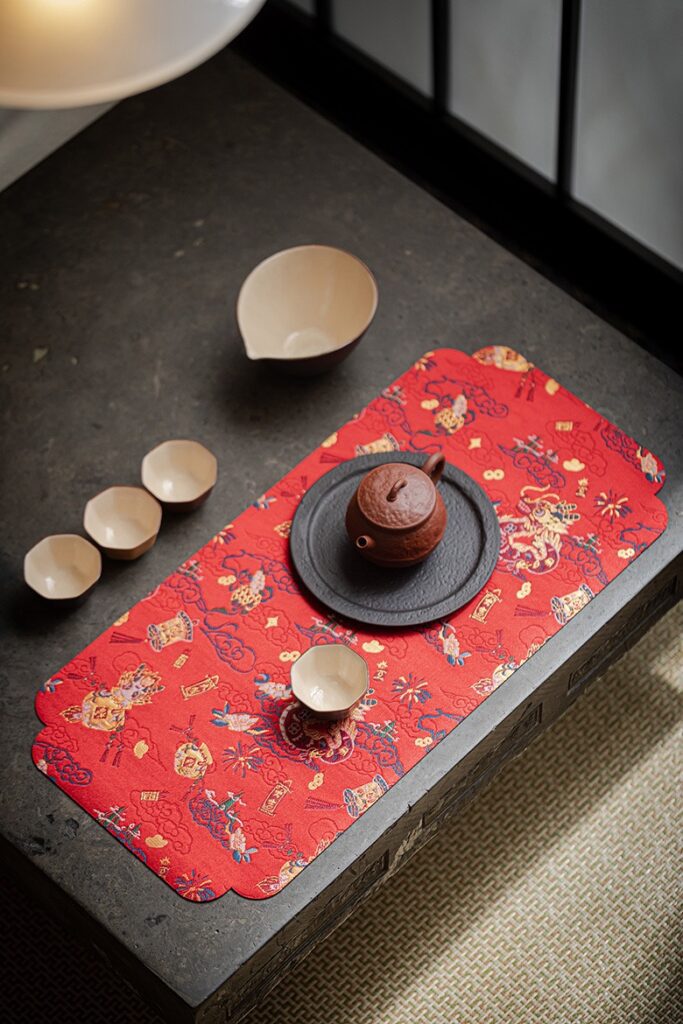
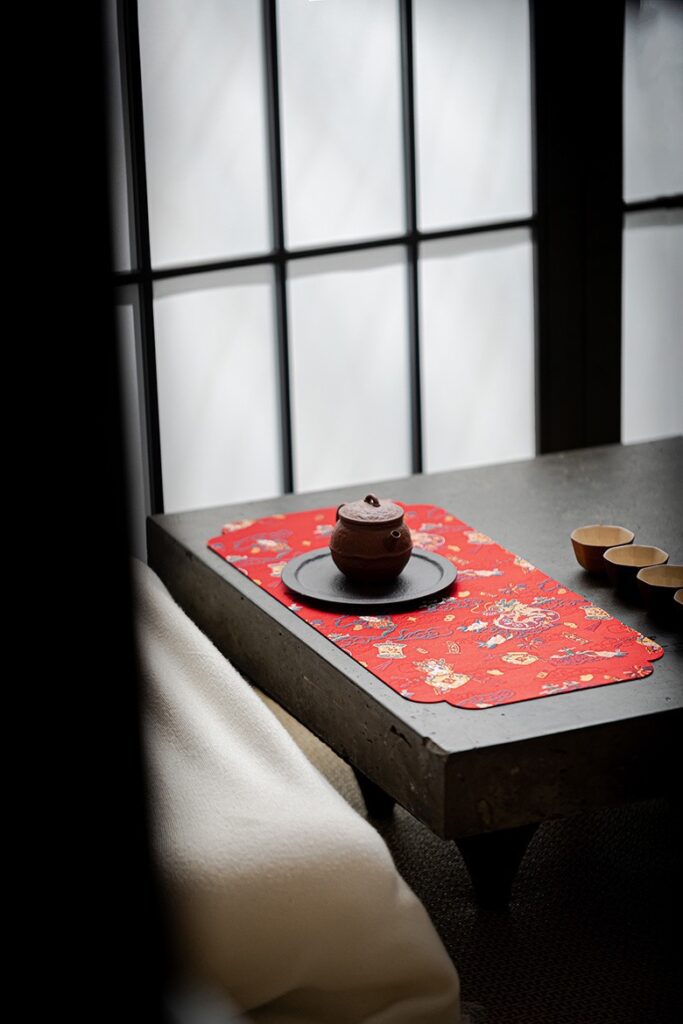
Hallo Teeliebhaber! 🐉✨ Spannende Neuigkeiten zum Start ins Jahr des Drachen 2024 – beim Kauf einer Yixing-Teekanne schenken wir euch eine exklusive Teematte im Stil des Jahres des Drachen, die euren Teeritualen das gewisse Etwas verleiht. So möchten wir gemeinsam mit euch feiern, aber denkt daran: Dieses Angebot gilt nur für begrenzte Zeit! Lasst euch die Gelegenheit nicht entgehen, eure Teestunden mit diesem mystischen Accessoire zu etwas ganz Besonderem zu machen. 🍵💫
Hallo, liebe Teeliebhaber! Viele von euch kennen uns zwar als Anbieter hochwertiger chinesischer Teegeschirre. sind wir auch auf Tees aus der Region Huang Shan spezialisiert. Huang Shan ist die Heimat der berühmtesten chinesischen Teesorten – Huang Shan Mao Feng, Keemun und Tai Ping Hou Kui. Als Einheimische dieses atemberaubenden Ortes haben wir eine tiefe Verbindung zu dieser Gegend und ihrem reichen Tee-Erbe.
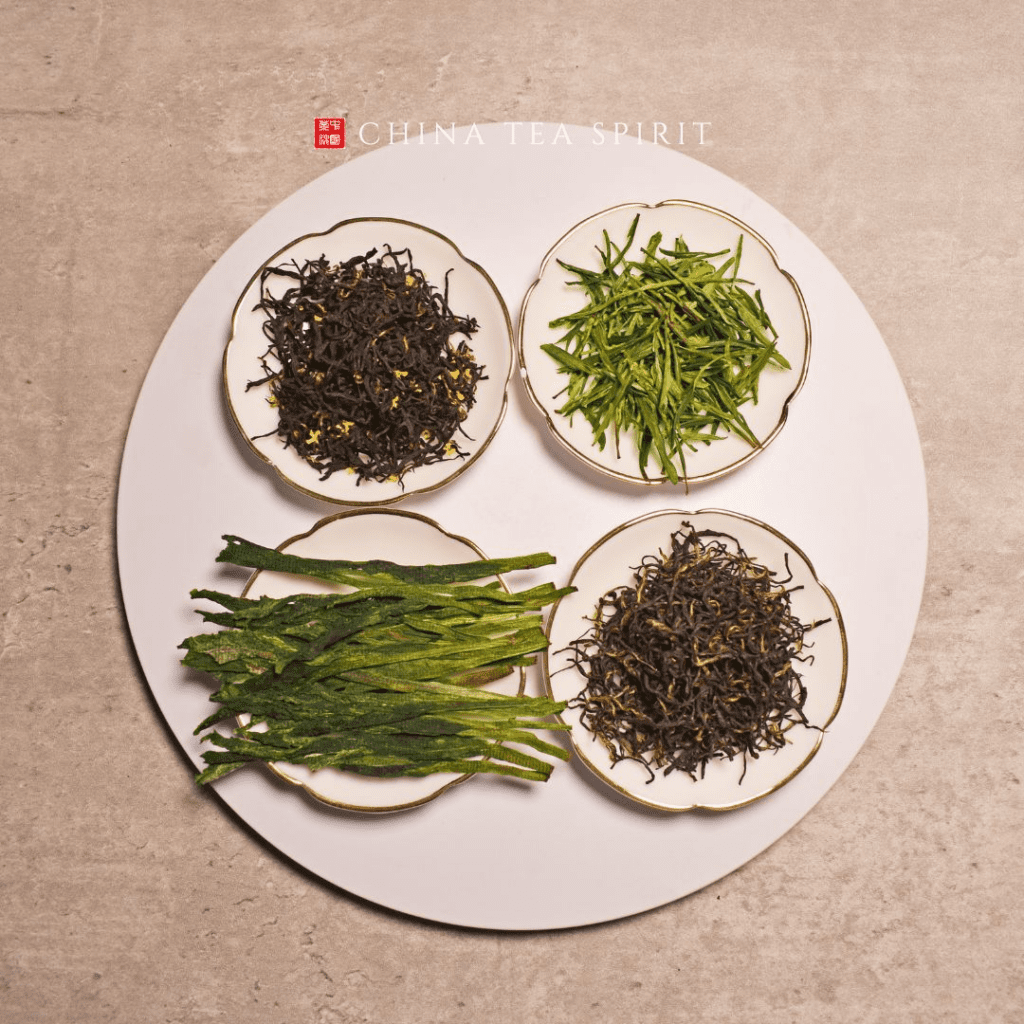
Wir wissen, dass die Suche nach dem perfekten Tee eine ganz persönliche Reise sein kann – deshalb bieten wir unser Probierpaket an. Damit können Sie die vielfältigen Aromen der Huang-Shan-Tees erkunden und denjenigen entdecken, der Ihren Geschmack trifft.
Jeder dieser Tees wird direkt von den Teebauern bezogen und verarbeitet, wodurch die Qualität und der authentische Geschmack gewährleistet sind.
Probierset mit folgendem Inhalt: Huang Shan Mao Feng – 10 g Tai Ping Hou Kui – 10 g Keemun Mao Feng – 10 g Osmanthus Keemun – 10 g
Wir freuen uns schon sehr auf Ihr Feedback zu unseren Teesorten. Begleiten Sie uns auf dieser Reise und lassen Sie sich von uns durch die bezaubernde Welt der Huang-Shan-Tees führen.
Bitte beachten Sie, dass der Tee und das Teegeschirr gemäß den Zollvorschriften in separaten Paketen versandt werden. In der Regel trifft der Tee etwas später ein als das Teegeschirr.
Sehr geehrte Kunden,
Sollten beim Bezahlvorgang Probleme aufgetreten sein, kontaktieren Sie uns bitte unter [email protected]. Und wir werden dir dabei helfen.
Im Folgenden haben wir häufige Zahlungsfehler und deren Lösungen als Orientierungshilfe für Sie aufgelistet.
#1: China Tea Spirit liefert nicht an diesen Standort. Bitte geben Sie eine andere Adresse an.
Dies ist ein bekannter Fehler bei PayPal. Er tritt zufällig auf. Falls Ihnen diese Fehlermeldung angezeigt wurde, kontaktieren Sie uns bitte unter [email protected]. Wir werden das für Sie regeln.
The name covers a surprisingly wide range of aromas. Understanding the difference between yellowing and roasting makes that range much easier to enjoy.
A description of yellow tea can promise something gentle and sweet. Another can conjure up toasted grain or the crisp edge of cooked rice. Both can belong to the same tea category. Before deciding that one description must be wrong, it helps to ask what happened to the leaves between picking and packing.
“Yellow tea” gives us a starting point. It leaves a great deal of the story untold.
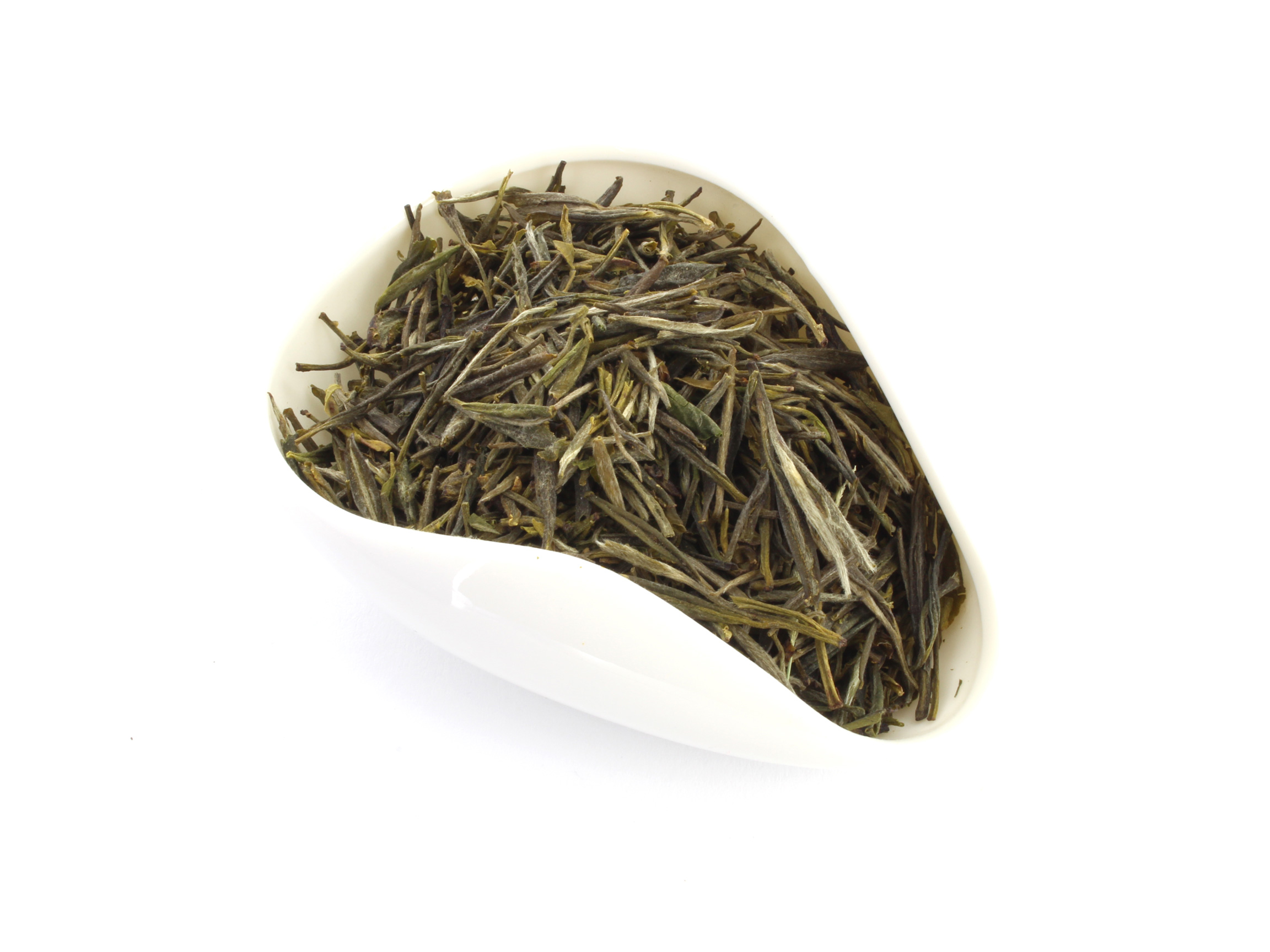
Chinese yellow tea identified by the photographer as “Huang Ya.” Its precise origin is unspecified. Photograph: KirillK / Wikimedia Commons, CC0.
A warm, deliberate pause
The defining operation is yellowing, or menhuang (闷黄): a controlled period of warm, moist conditions during manufacture. Temperature, moisture, time and ventilation all matter. Change those conditions and the result changes too. The word names a process with choices inside it, rather than a single recipe shared by every producer.
A broad scientific review describes refreshing, sweet aromas in bud and small-leaf yellow teas, alongside a crispy-rice character associated with roasting in large-leaf examples. That range is worth keeping in mind before treating “delicate” as a universal requirement. The review appeared online in April 2023 and in a 2024 journal issue. Read the review.
For a drinker, the useful question is what kind of character the maker was trying to develop. A fragrant, restrained tea and a deeply roasted one invite different expectations. Judging both against the same imagined cup can make an intentional style seem like a disappointment.
What happened to the grassy aroma?
A study published in February 2026 followed Mengding bud yellow tea through production. Researchers combined sensory assessment with chemical analysis, identifying yellowing as an important point in the shift from grassy aromas toward sweet and umami-associated qualities. They also investigated aroma compounds and the transformations contributing to that development. Read the Mengding study.
There is something compelling about that shift: part of the craft takes place during a hold, when the leaves may appear to be doing very little. Time under controlled conditions is productive work.
This was research on a particular tea and manufacturing sequence. It does not establish that every yellow tea should smell identical, or that a tea described as sweet must have a sugary taste. An aroma description tells us what a smell recalls; it is not a measurement of sweetness in the cup.
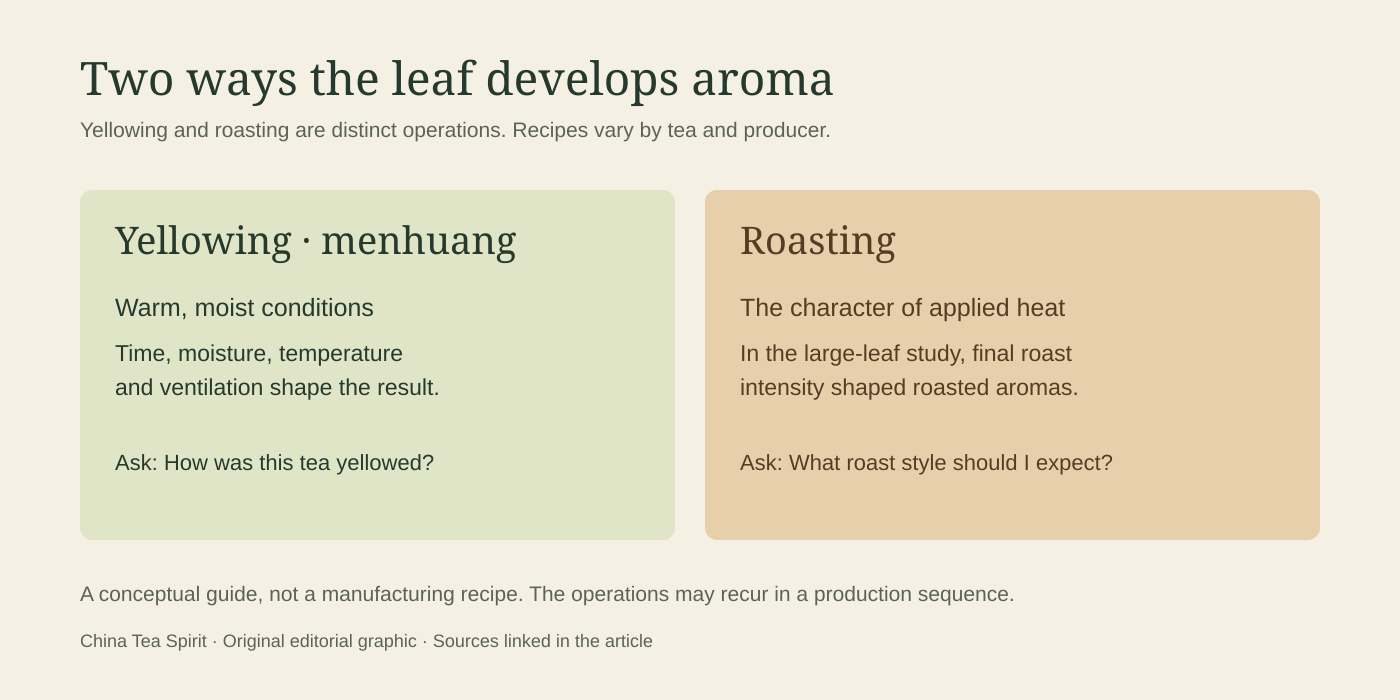
Two operations, two useful questions. This explanatory graphic is a conceptual guide, not a production recipe or a reproduction of either study’s figures.
The grain-like side of the family
For a different view, consider large-leaf yellow tea, or huangdacha. In a 2025 industrial-scale study, researchers followed tea made in Lu’an, Anhui, using shoots with a bud and more than three leaves. The manufacturing sequence included repeated yellowing and roasting, with different final roast levels examined.
The final roasting stage mattered greatly. Pyrazines associated with roasted notes formed chiefly during that stage and increased with roasting intensity; some floral compounds declined over manufacture. The sensory assessment included malty, roasted, caramel-like and cooked-corn descriptions. Read the large-leaf study.
This gives “toasted grain” a firmer explanation than simply calling it the taste of yellowing. Yellowing and roasting both helped shape these samples, and their contributions need to be understood separately.
It also changes how we look at the leaves. A larger plucking standard need not be judged as an unsuccessful attempt at a bud tea. Here, it was the starting material for a different product. The interesting question is how well the finished tea expresses its intended character.
Put the descriptions beside the cups
A small comparison can make these distinctions more tangible. Choose two named yellow teas with clearly different descriptions, ideally one emphasizing sweet fragrance and another emphasizing roast. Keep the packaging nearby and begin with each producer’s brewing guidance. Treat the exercise as a conversation with the descriptions rather than an exam with one correct answer.
First, write down what you notice before rereading the tasting notes. Does the fragrance suggest flowers, vegetables, grain, or something else entirely? Then separate that impression from the experience of drinking: how does the liquid feel, and what remains after swallowing?
If “roasted” is the first word that comes to mind, look for a second one. Is it closer to bread crust, toasted rice, or a sharper charred edge? These are prompts for your own observations, not a checklist that every sample should satisfy.
A useful seller should be able to give more than a colour category: the tea’s name, origin, leaf material and, where known, its processing or roast style. Those details make it easier to choose the next cup without demanding that every yellow tea deliver the same pleasure.
The label opens the door. The maker’s decisions explain what is waiting inside.