Versandpause während der Feiertage – Wiederaufnahme am 8. Oktober. Feiern Sie das Mittherbstfest mit 10% Rabatt unter Verwendung des Codes „ctsmooncake“. SchließenZum Inhalt springen
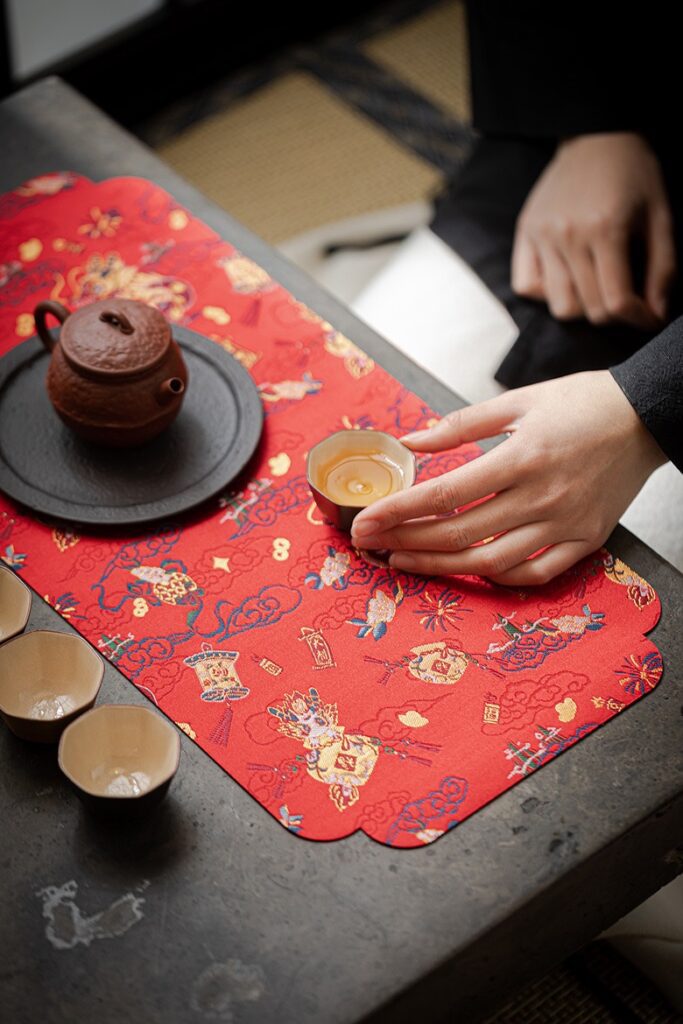
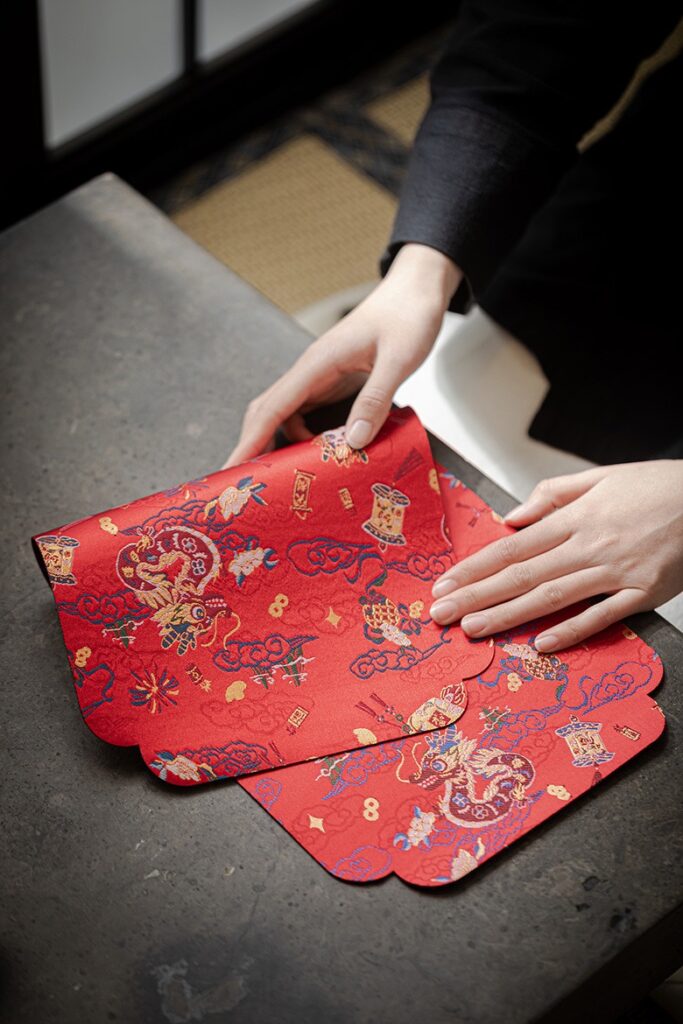
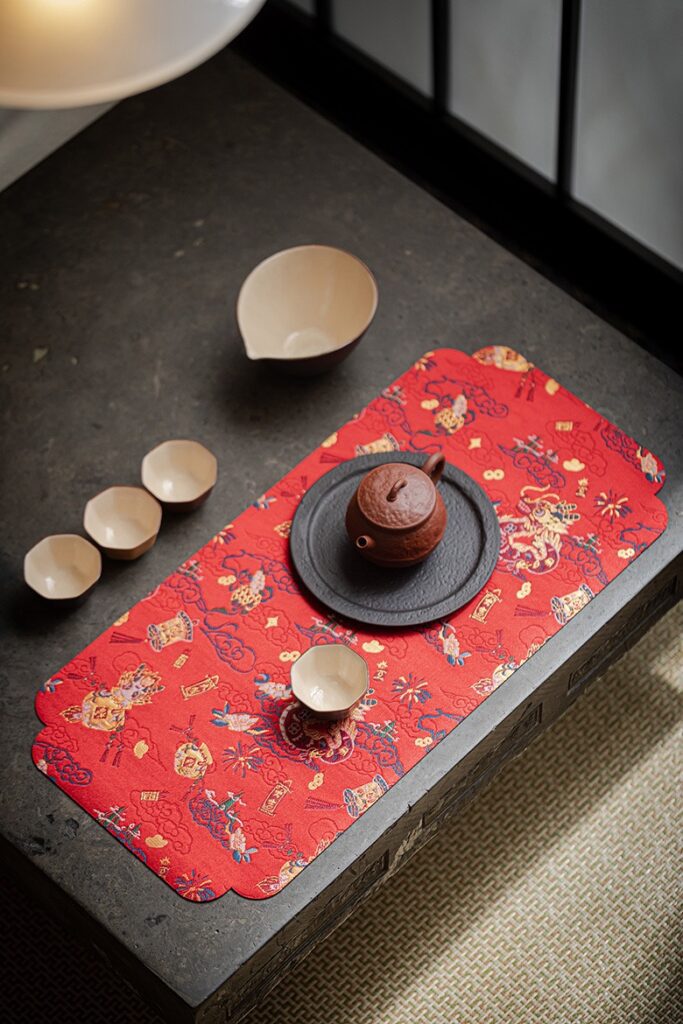
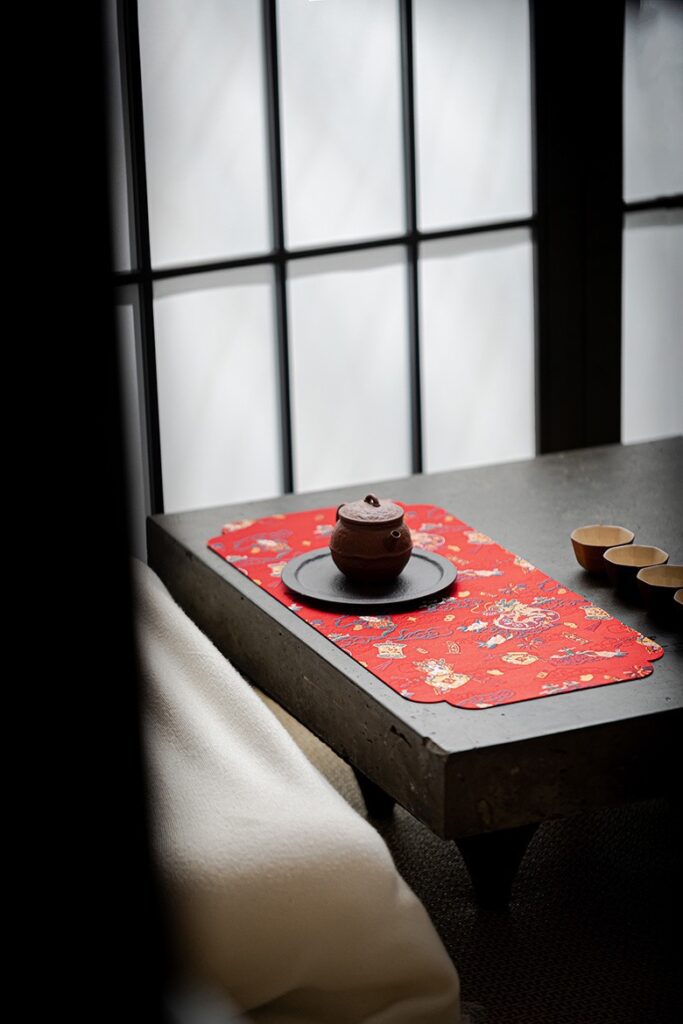
Hallo Teeliebhaber! 🐉✨ Spannende Neuigkeiten zum Start ins Jahr des Drachen 2024 – beim Kauf einer Yixing-Teekanne schenken wir euch eine exklusive Teematte im Stil des Jahres des Drachen, die euren Teeritualen das gewisse Etwas verleiht. So möchten wir gemeinsam mit euch feiern, aber denkt daran: Dieses Angebot gilt nur für begrenzte Zeit! Lasst euch die Gelegenheit nicht entgehen, eure Teestunden mit diesem mystischen Accessoire zu etwas ganz Besonderem zu machen. 🍵💫
Hallo, liebe Teeliebhaber! Viele von euch kennen uns zwar als Anbieter hochwertiger chinesischer Teegeschirre. sind wir auch auf Tees aus der Region Huang Shan spezialisiert. Huang Shan ist die Heimat der berühmtesten chinesischen Teesorten – Huang Shan Mao Feng, Keemun und Tai Ping Hou Kui. Als Einheimische dieses atemberaubenden Ortes haben wir eine tiefe Verbindung zu dieser Gegend und ihrem reichen Tee-Erbe.
Wir wissen, dass die Suche nach dem perfekten Tee eine ganz persönliche Reise sein kann – deshalb bieten wir unser Probierpaket an. Damit können Sie die vielfältigen Aromen der Huang-Shan-Tees erkunden und denjenigen entdecken, der Ihren Geschmack trifft.
Jeder dieser Tees wird direkt von den Teebauern bezogen und verarbeitet, wodurch die Qualität und der authentische Geschmack gewährleistet sind.
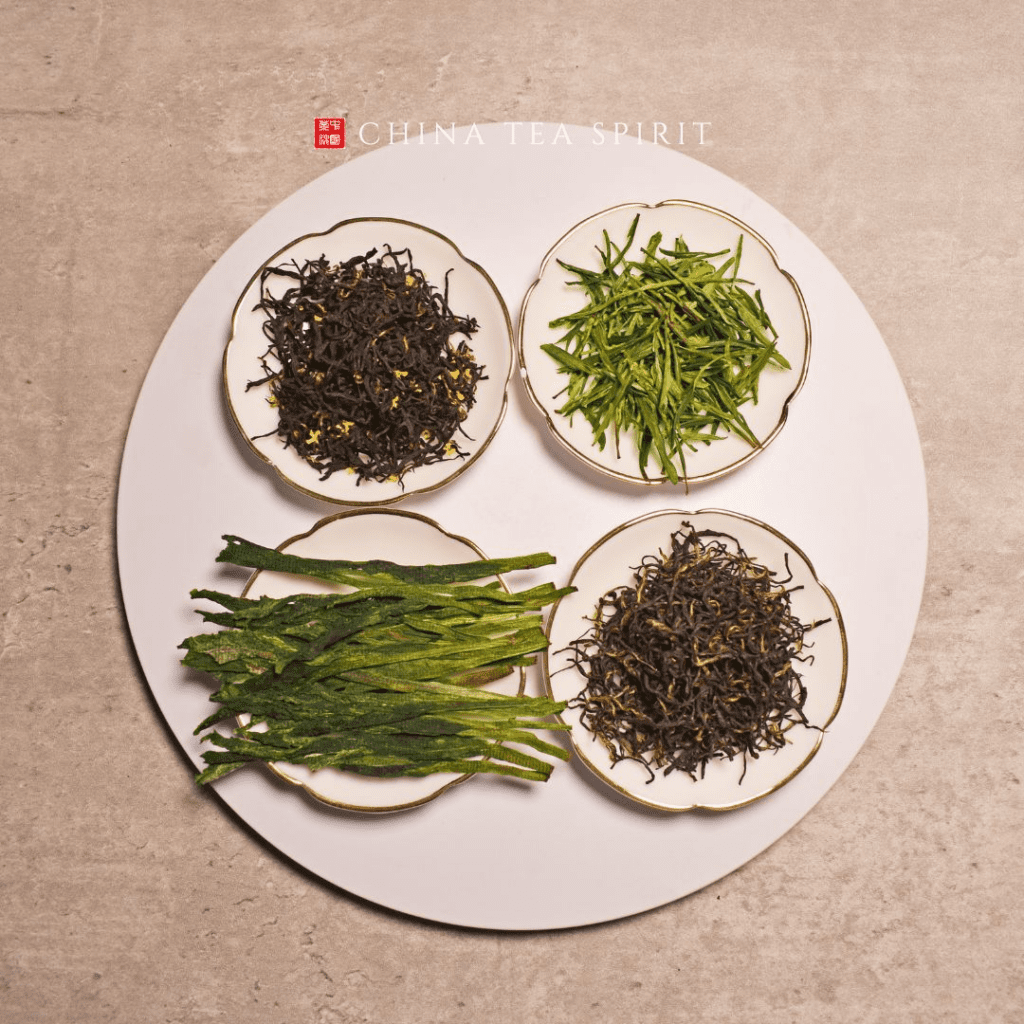
Probierset mit folgendem Inhalt: Huang Shan Mao Feng – 10 g Tai Ping Hou Kui – 10 g Keemun Mao Feng – 10 g Osmanthus Keemun – 10 g
Wir freuen uns schon sehr auf Ihr Feedback zu unseren Teesorten. Begleiten Sie uns auf dieser Reise und lassen Sie sich von uns durch die bezaubernde Welt der Huang-Shan-Tees führen.
Bitte beachten Sie, dass der Tee und das Teegeschirr gemäß den Zollvorschriften in separaten Paketen versandt werden. In der Regel trifft der Tee etwas später ein als das Teegeschirr.
Sehr geehrte Kunden,
Sollten beim Bezahlvorgang Probleme aufgetreten sein, kontaktieren Sie uns bitte unter [email protected]. Und wir werden dir dabei helfen.
Im Folgenden haben wir häufige Zahlungsfehler und deren Lösungen als Orientierungshilfe für Sie aufgelistet.
#1: China Tea Spirit liefert nicht an diesen Standort. Bitte geben Sie eine andere Adresse an.
Dies ist ein bekannter Fehler bei PayPal. Er tritt zufällig auf. Falls Ihnen diese Fehlermeldung angezeigt wurde, kontaktieren Sie uns bitte unter [email protected]. Wir werden das für Sie regeln.
In a familiar pair of Chinese guardian lions, one animal rests a paw on a patterned ball. Beside the other is a small cub. Both may have curled manes, broad mouths and wonderfully theatrical expressions, but those little details tell you they are not simply two copies of the same sculpture.
They are also not dogs. Despite the English names Foo Dogs und Fu Dogs, these figures belong to the tradition of Chinese guardian lions.
Once you notice the ball, the cub and the stance, a figure that initially seemed like a strange decorative animal becomes much easier to read. The expression is only the beginning.
A dog in the name, a lion in the design
Foo dog, fu dog und lion dog are English names used for these stylized lions. In Chinese, shizi means lion; shishi refers to stone lions. The English nickname is not a literal translation of either term.
It is worth separating that naming habit from the object itself. A figure sold as a Foo Dog is not necessarily depicting a particular breed of dog. For identifying the artistic tradition, Chinese guardian lion is the clearer description. Even museum catalogues can preserve both names: the Penn Museum’s record of a Qing cloisonne lion lists Fu Lion and Fu Dog together, while describing the animal as a lion.
The face can still look surprisingly dog-like. That is understandable when you look at the rounded muzzle, close-set curls and compact body. But resemblance is not the same as identity.
Why the lion became something distinctly Chinese
Die Metropolitan Museum of Art notes that lions were not native to China, although some had arrived from the west by the Western Han period. As Buddhism became firmly established, the lion also acquired a powerful role as a defender of the faith and Buddhist law.
That history helps explain why a Chinese lion can communicate much more than animal strength. It belongs to an artistic world of guardianship, sacred settings and authority.
Incense burner with lions, China, second half of the sixth century. Glazed earthenware. The Metropolitan Museum of Art, Fletcher Fund, 1927, accession 27.46. Public Domain.
Look at the lions supporting this sixth-century vessel. They do not resemble the gilded palace pair above, yet their crouched bodies and animated faces have an unmistakable presence. The example also shows that lions were appearing on small objects, not only at gateways.
On the palace lions, curls become almost architectural. Claws, teeth and eyes are enlarged into features you can read from a distance. You do not need to mistake the sculpture for a living animal to understand that it is watching the entrance.
The ball and the cub are better clues than the mane
In the familiar paired arrangement, the lion with the ball is the male, while the one with a cub is the female. The Penn Museum identifies its female lion by the cub beneath her feet. A mane alone is not a reliable way to tell them apart in this stylized tradition.
Notice how much the cub changes the mood. The adult may still look imposing, but the smaller animal introduces a scene of contact and play. The ball does something similar: it gives the raised paw a purpose.
For a collector, these details are more useful than trying to decide whether one face looks sufficiently fierce or whether a mane has the right number of curls. They are also reasons to ask for a complete photograph rather than a close-up of the head.
Treat this as a familiar convention, not a test that every Chinese lion in every medium must pass. A small ceramic interpretation may simplify the whole composition, leave out the companion or replace the accessory with something else.
Not every lion-like beast is Suanni
This is where a little context helps more than a longer list of horns and claws.
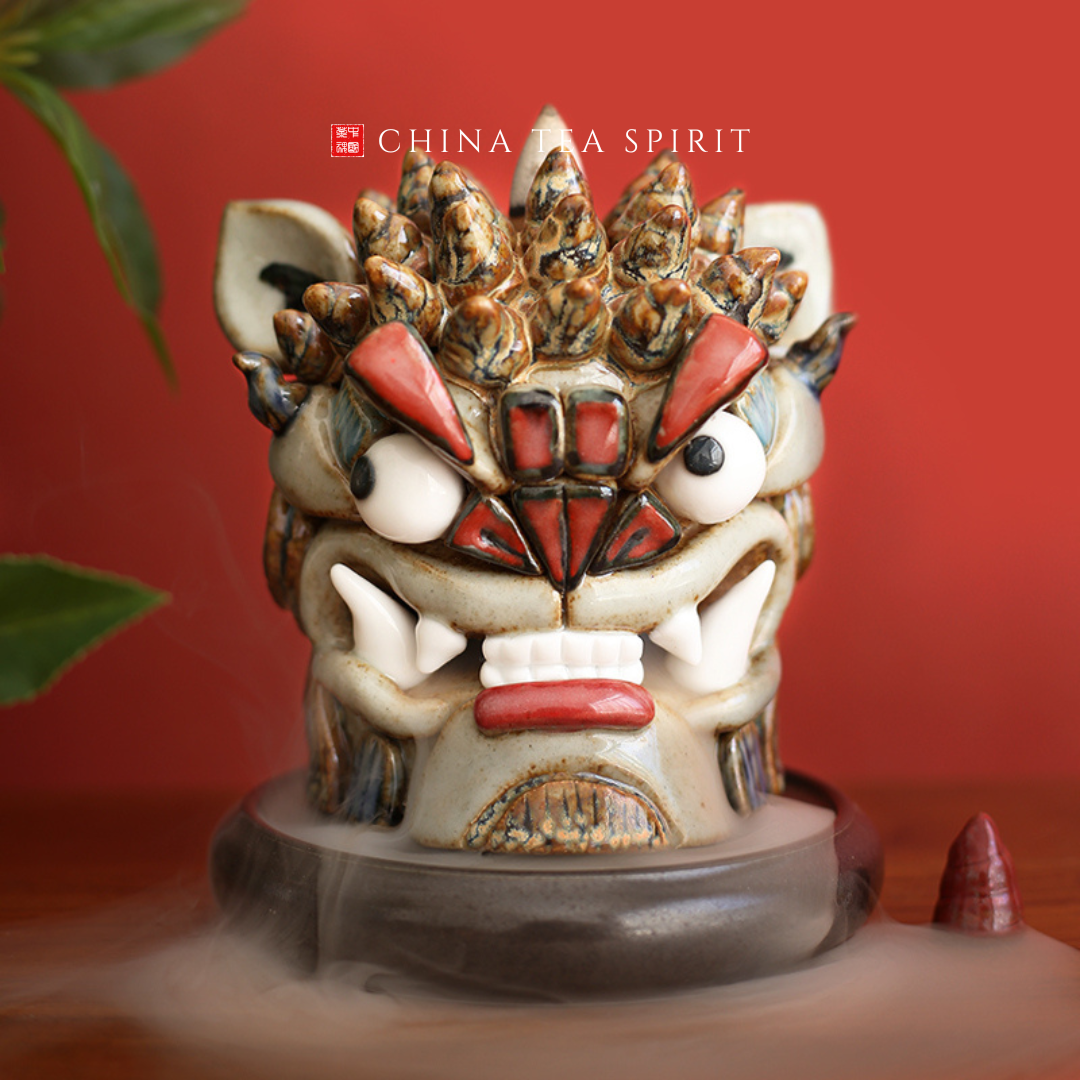
Guardian lion is a useful name for the protective lion tradition, especially the paired figures at entrances. Suanni has an overlapping lion-related history, but later stories give it a place among the Dragon’s sons and associate it with quiet sitting and smoke. The Der Bericht des Palastmuseums über die neun Söhne describes that incense-related role.
A contemporary Suanni from China Tea Spirit. Similar lion-like features do not make every sculpted beast the same creature.
The traditions can share a face without sharing every story. A maker’s description, the setting and the way an object functions are all worth considering before assigning a name.
The same caution applies to Pixiu. A broad mouth and a forceful expression do not automatically turn a lion into the wealth-associated mythical beast.
Small guardians are not a new invention
It is tempting to imagine a simple journey from enormous palace sculpture to tiny modern ornament. Surviving objects make that story less tidy.
That does not make today’s ceramic tea pets ancient objects. It does show how comfortably the lion can work at different scales. A large guardian commands a doorway. A small one invites a closer look.
When a guardian becomes a tea-table companion
The shift in scale changes the relationship. The face that would look formidable above a flight of steps can feel almost mischievous beside a gaiwan.
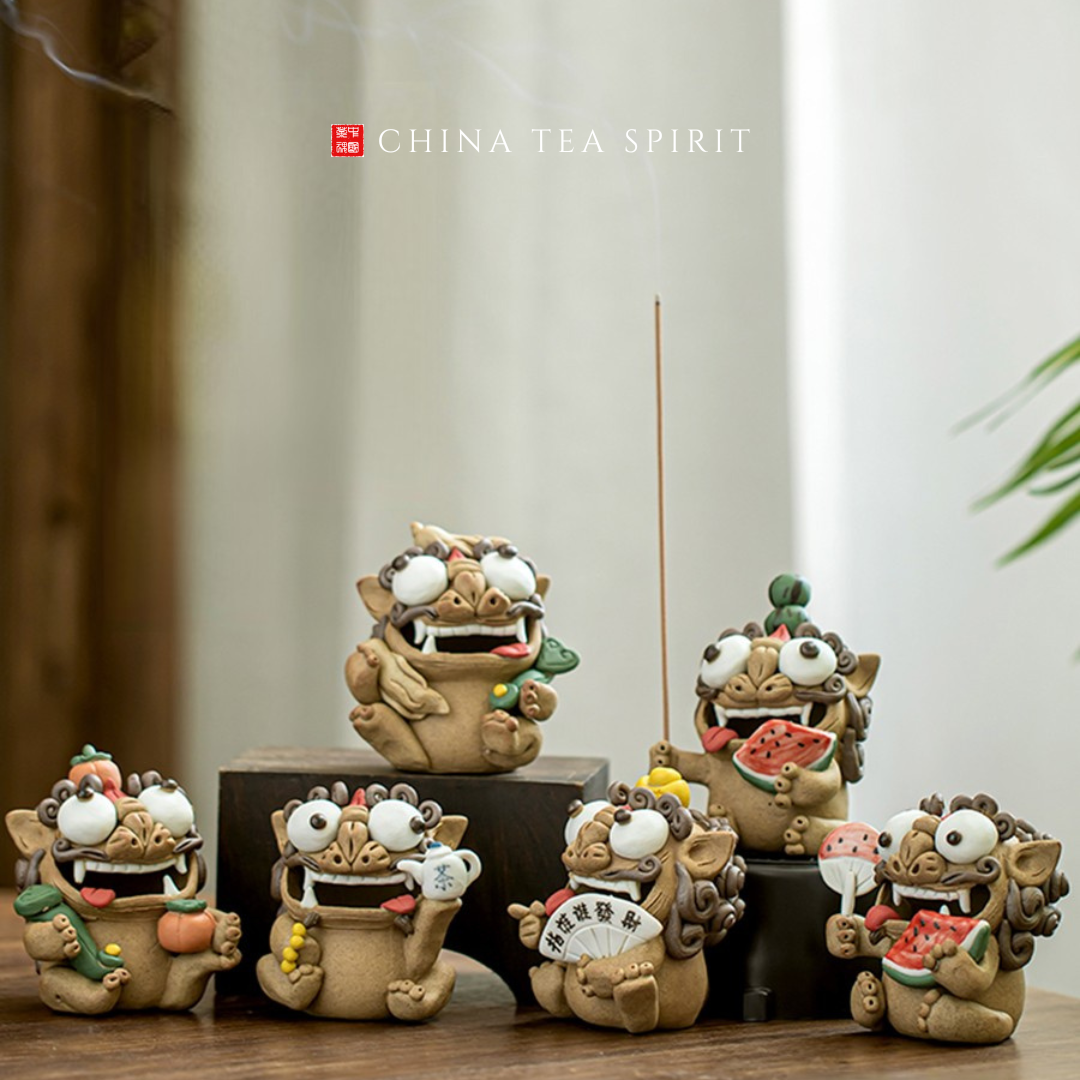
Unser Foo Dog tea pet is a contemporary handmade Jingdezhen ceramic interpretation. It belongs to this more playful end of the lion tradition, rather than reproducing one particular historic palace statue.
A modern ceramic lion tea pet from China Tea Spirit. An old subject can take on a much more personal character.
A single figure can be enjoyed as a sculpture without pretending it is a complete ceremonial pair. When choosing one, look at the actual piece: its proportions, its expression and the details that make you want to keep noticing it.
The appeal need not depend on a promise that it will change your fortune. A small guardian can mark a space as yours simply by becoming a familiar part of it.
The next time you meet one of these creatures, start at the paws. Then look at the face again. A ball, a cub or a carefully chosen accessory can turn a generic “Foo Dog” into a much more particular object—and a much better story.