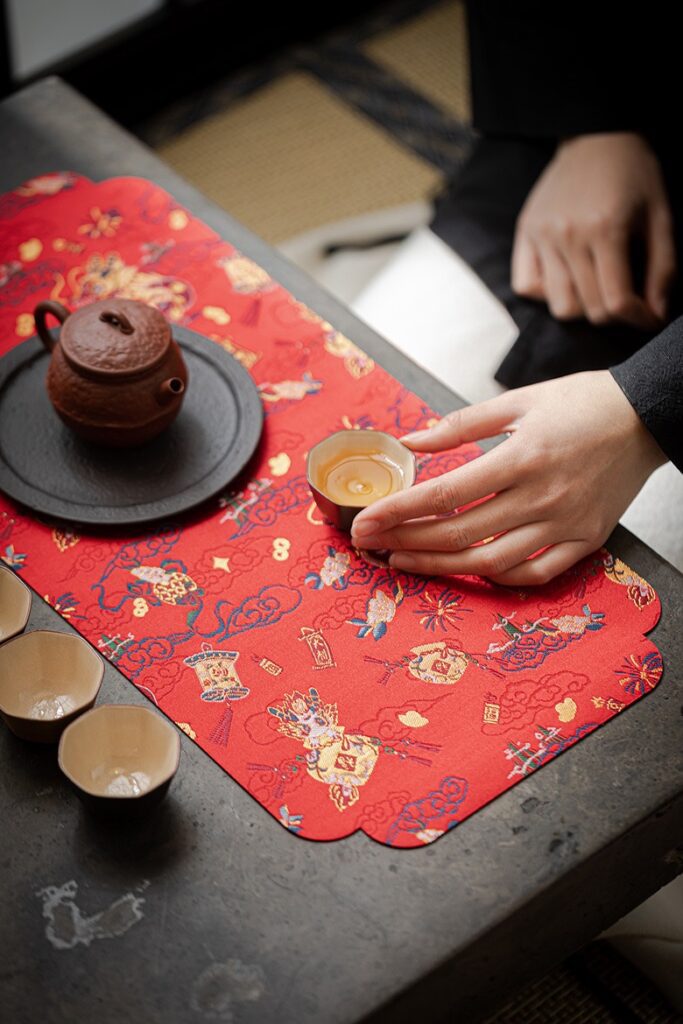
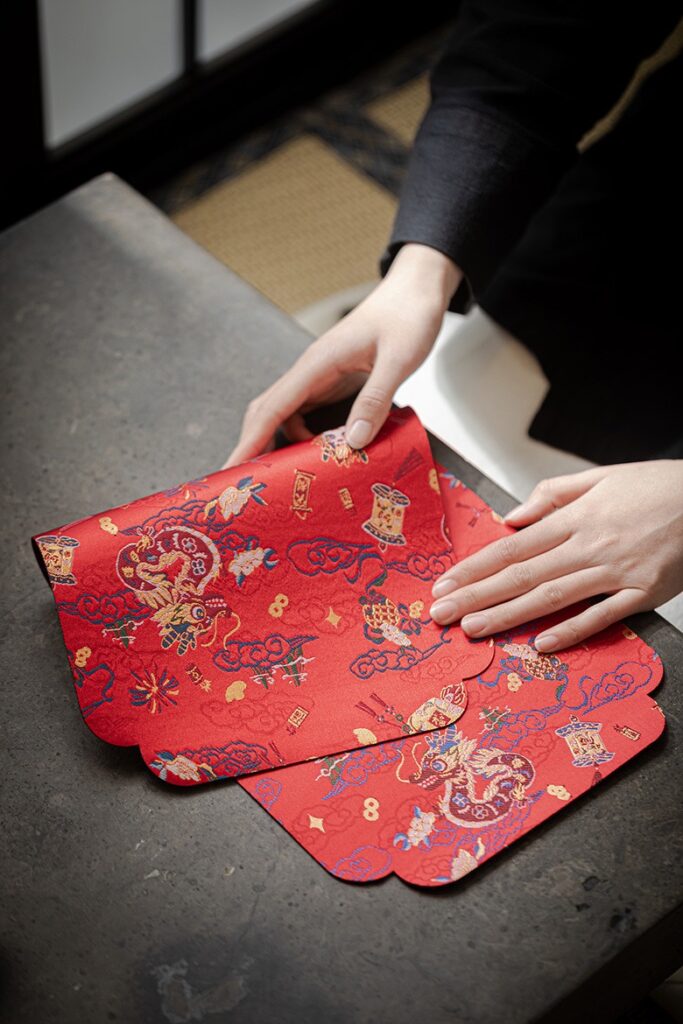
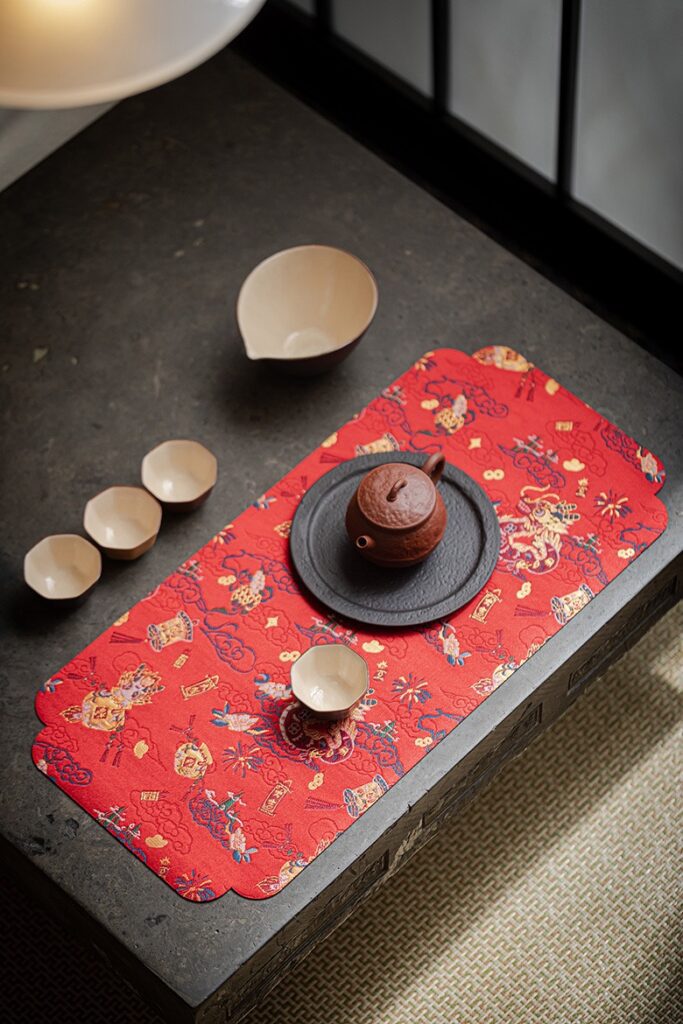
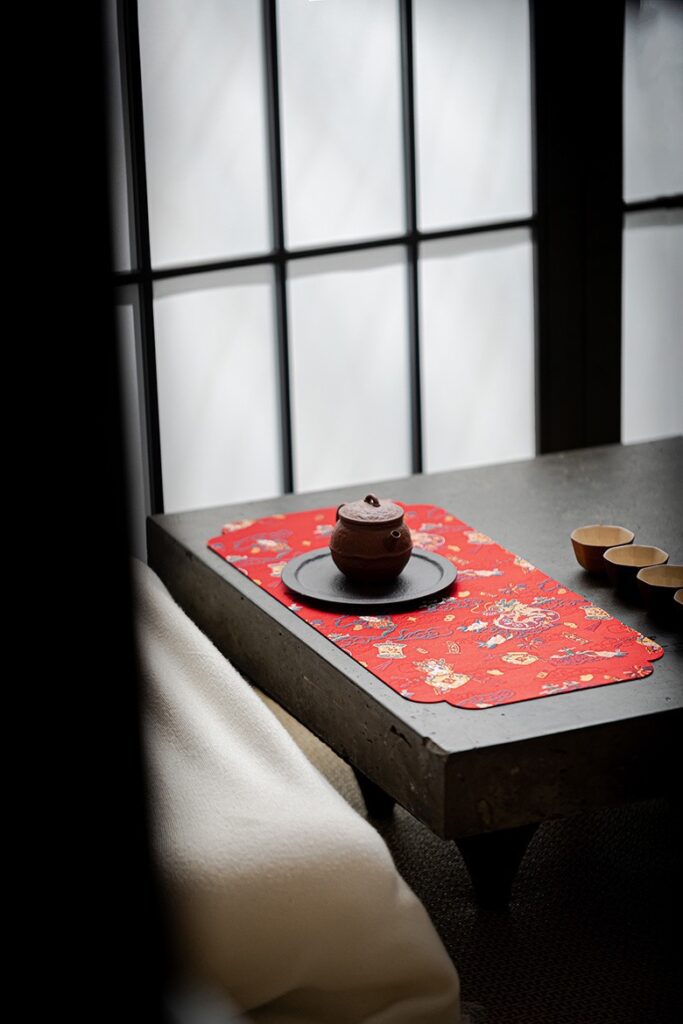
お茶好きの皆さん、こんにちは!🐉✨ 2024年の辰年を迎えるにあたり、嬉しいお知らせです。宜興(イシン)の急須をご購入いただいたお客様には、お茶のひとときに特別な彩りを添える、辰年限定デザインの茶敷きをプレゼントいたします。 これは皆様と共にこの年を祝うための私たちのささやかな贈り物ですが、期間限定のオファーですのでお見逃しなく!この神秘的なアイテムで、お茶のひとときをさらに特別なものにしてください。🍵💫
If you spend enough time around Chinese tea tables, antique shops or traditional decorations, you start seeing the same squat little creature again and again.
It looks like a toad. Usually a very well-fed one.
It may be sitting on coins, holding one near its mouth, or staring up from the edge of a tea tray with an expression that is somewhere between serious and ridiculous.
This is Jin Chan, commonly translated as the Golden Toad and better known in English as the マネー・フロッグ または マネートード.
The modern explanation is simple: Jin Chan is a symbol of wealth.
That is true. But it is also only the latest layer of a much older story.
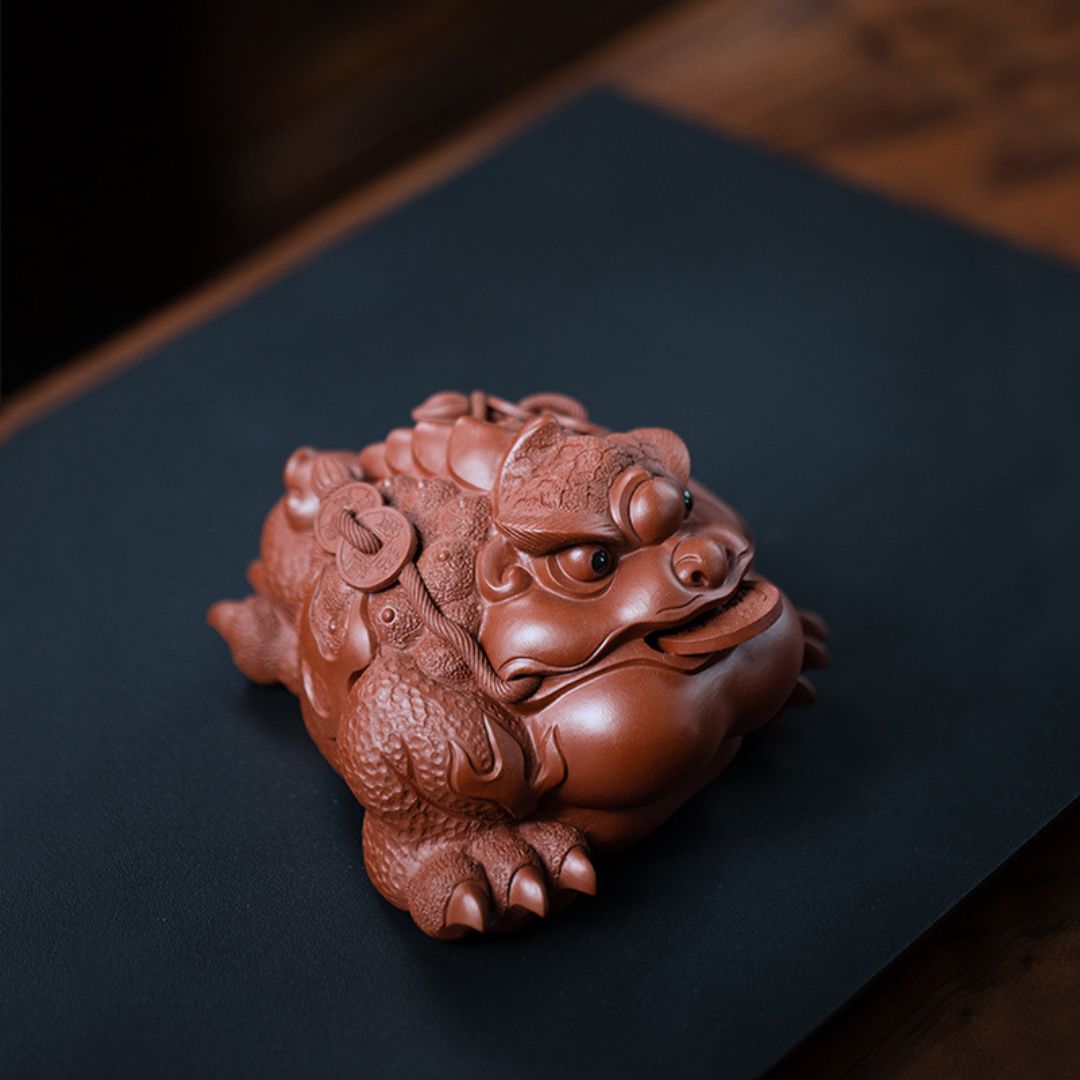
English does not make this creature especially easy to name.
You will see マネー・フロッグ, マネートード, Three-Legged Frog そして Three-Legged Toad used almost interchangeably. “Money Frog” is probably the friendliest modern name, but toad is closer to the traditional creature: chan refers to a toad.
And visually, that makes sense.
Jin Chan is usually not imagined as a delicate little pond frog. It tends to be round, heavy and firmly planted. That solid, slightly awkward body is part of what makes the creature so recognizable in sculpture.
The three-legged toad did not begin as a Feng Shui mascot.
Toads have a much older place in Chinese lunar imagery. An Eastern Han carved stone in the 故宮博物院, for example, places a toad inside the moon while the sun contains the three-legged crow.
Centuries later, the association was still recognizable. The メトロポリタン美術館 describes a fourteenth-century water dropper in the form of a three-legged toad as a mythical creature believed to dwell on the moon. The object also carried auspicious associations with prosperity and success in the civil-service examinations.
So the creature already had a symbolic life long before the modern Money Frog became familiar.
Money came later.
This is where the Jin Chan most people recognize begins to take shape.
Liu Hai, also known as Liu Haichan, became an important figure in popular Daoist tradition. By the Ming period, he was strongly associated with the three-legged toad, and artists repeatedly paired the two.
その Met preserves an eighteenth- to nineteenth-century bamboo carving of Liu Hai astride a toad. Another Qing-dynasty object in the museum records a popular version of the legend in which Liu Hai’s three-legged toad escapes down a well and he fishes it back using a line baited with coins.
That image—Liu Hai, the strange three-legged toad and money—became extremely durable.
Over time, the toad itself could carry the auspicious meaning even when Liu Hai was no longer present.
The lunar toad had become the Money Toad.
This feels like the sort of detail that should have one wonderful mythological explanation.
It does not.
Later folk stories offer several explanations for the missing leg, and they do not all agree. Some describe the toad as a troublesome creature subdued by Liu Hai. Others attach different stories to its unusual body.
The more useful point is that the three-legged form itself is old. Historical artworks already show three-legged toads in lunar, scholar and auspicious contexts.
In other words, the missing leg is not a modern gimmick added to make the Money Frog look mystical. It is part of the creature’s established visual identity.
Here the symbolism is easier to follow.
The stories and images surrounding Liu Hai repeatedly connect the three-legged toad with cash coins. As the pairing became an auspicious image of prosperity, later Jin Chan figures increasingly made the money symbolism explicit.
Coins might appear beneath the toad, around it, on a cord, or eventually in and around its mouth.
That visual shorthand became so familiar that the creature no longer needed Liu Hai beside it.
A squat three-legged toad surrounded by coins was enough.
This is a small distinction, but it is worth keeping.
A ceramic frog sitting on a tea tray is not automatically a Money Frog.
Jin Chan usually carries clues that connect it with the older three-legged toad tradition—the unusual number of legs, money imagery, or a clearly auspicious composition.
Contemporary tea pets are much freer. Sometimes an artist makes a frog simply because frogs are expressive, funny animals.
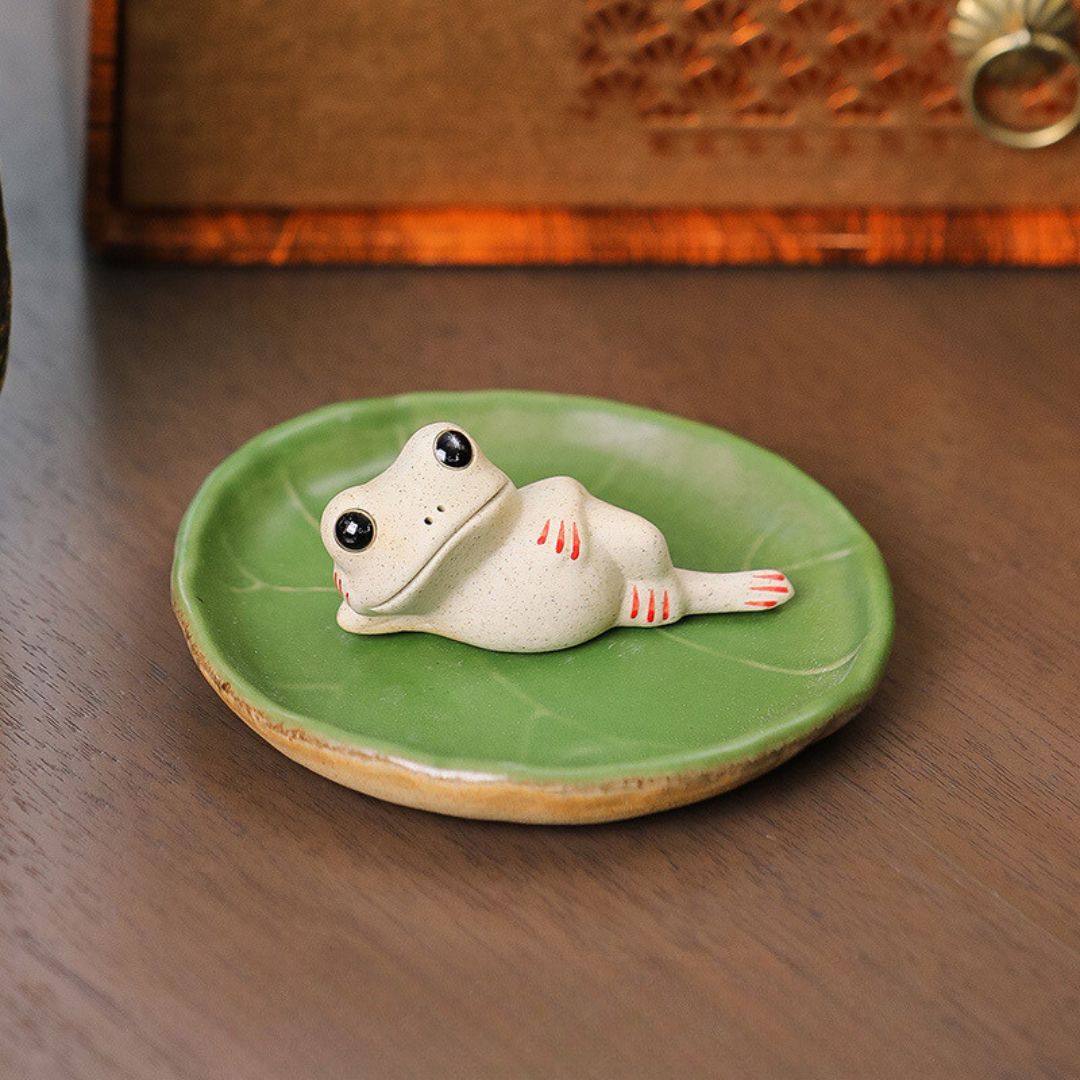
That difference makes the symbolism more meaningful, not less.
If every frog-shaped object is given the same ancient story, eventually the story stops telling us very much.
A formal auspicious ornament is often meant to be looked at.
A tea pet is lived with.
It sits beside the gaiwan. Tea is poured over it. Unglazed clay gradually darkens and develops character. The object becomes familiar through repetition.
That changes the feeling of Jin Chan.
The prosperity symbolism remains, but the creature becomes less formal and more personal. It can be serious, comical, sleepy or deliberately eccentric.
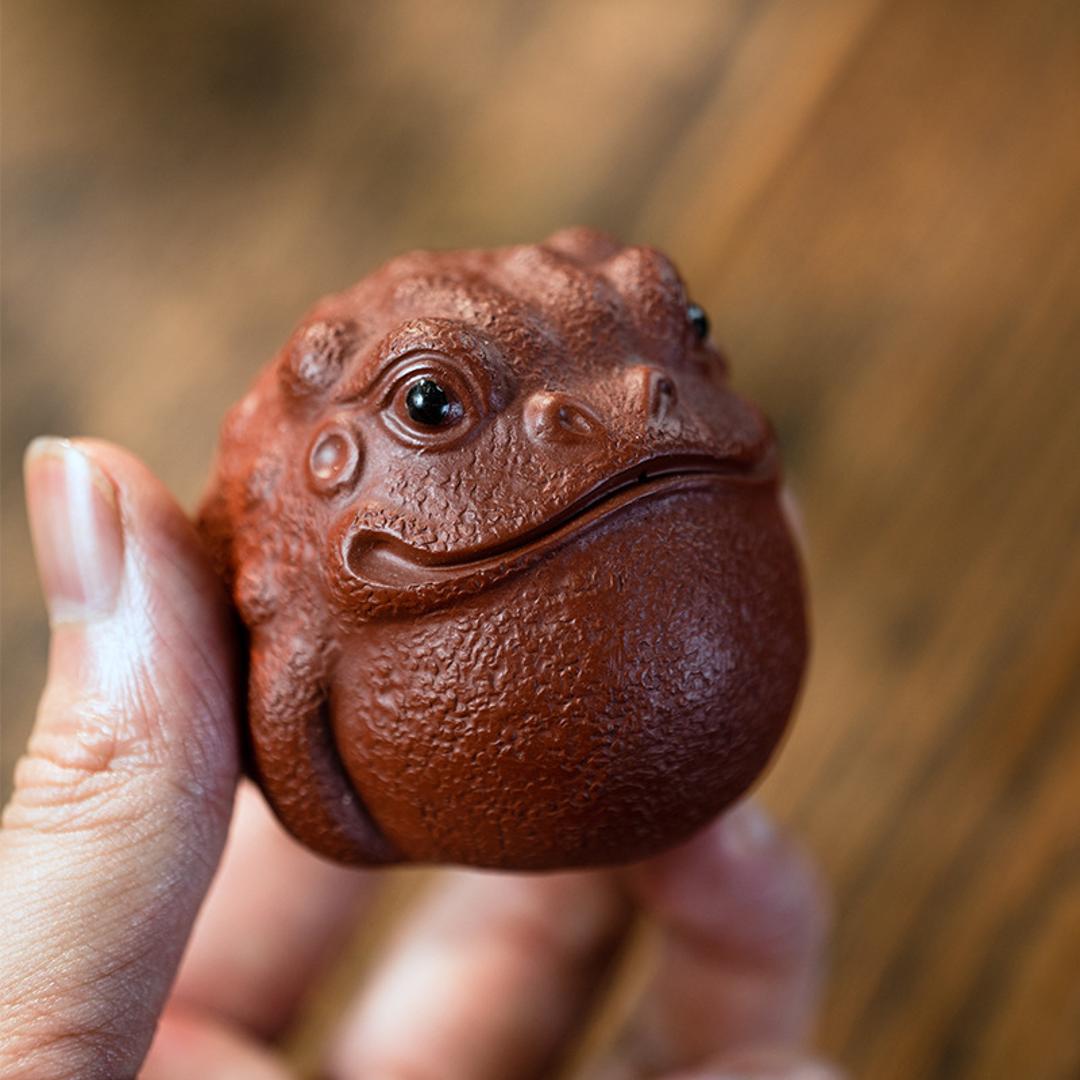
A piece such as our Nerdy Money Frog Tea Pet is a good example. The old three-legged wealth creature is still recognizable, but the maker is clearly having fun with it.
That is not a break from tradition.
It is one of the ways traditions stay alive.
Jin Chan is not limited to one material or one type of object.
Historical examples appear in bronze, bamboo, jade, ceramics and scholar’s objects. Contemporary versions continue that flexibility.
At China Tea Spirit, a more traditional three-legged Da Hong Pao clay Money Frog sits much closer to the familiar Jin Chan image, while other versions exaggerate the creature’s personality.
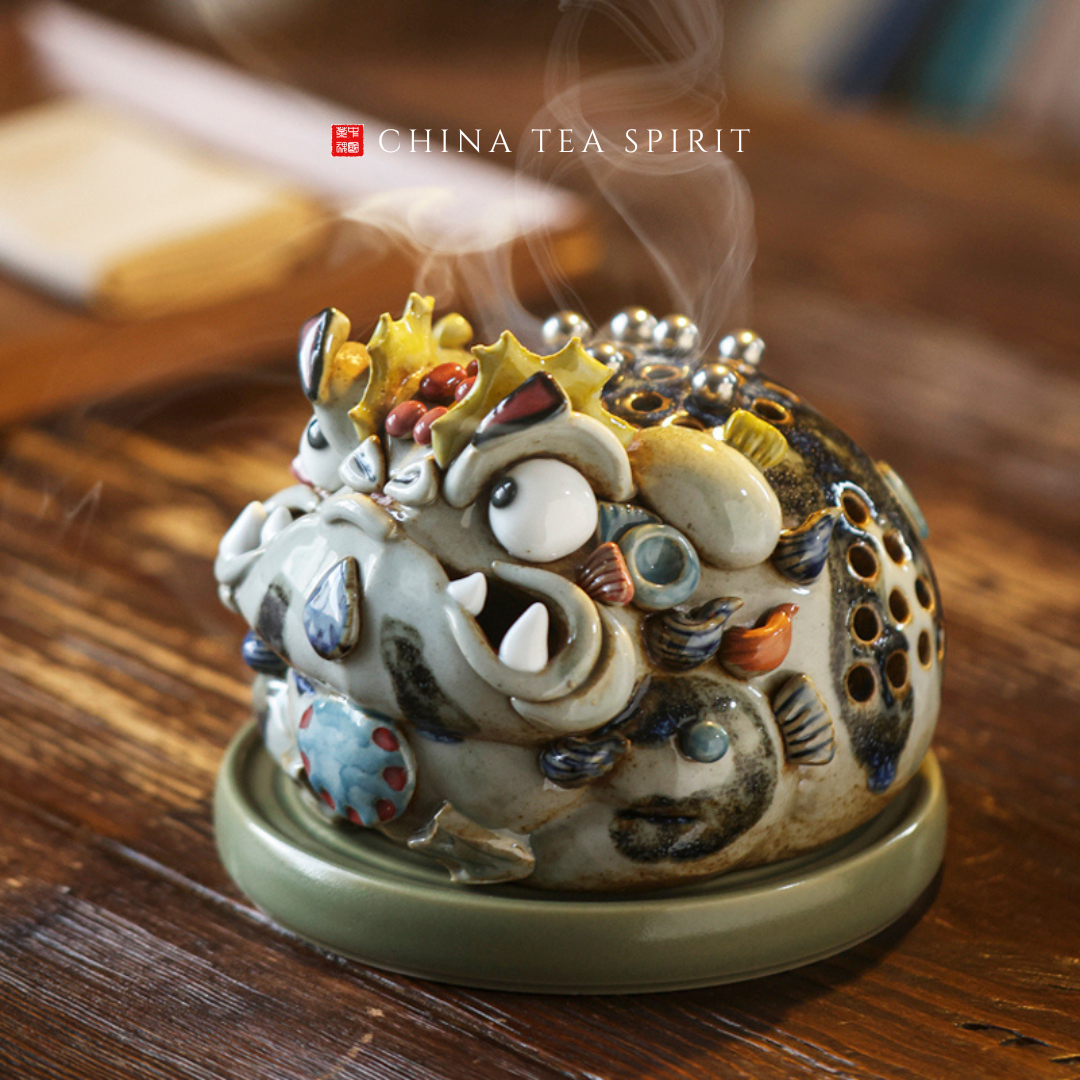
The same imagery can also move beyond tea pets into decorative ceramics, including our ceramic Money Frog piece.
What connects these objects is not one rigid design.
It is the accumulated identity of the creature: the three-legged toad, the old auspicious associations, the coins, and the centuries of stories that came to surround it.
If you meet Jin Chan only through modern Feng Shui shorthand, the creature can seem almost too simple.
Three legs. Coin in mouth. Good for money.
But that version compresses a much older and stranger story.
Behind the familiar Money Frog lies the lunar toad, scholar’s objects, Liu Hai and his string of coins, Daoist popular tradition, prosperity symbolism and generations of artists who kept reshaping the creature.
Eventually Jin Chan found its way onto the tea table, where something that once belonged to myth and auspicious imagery could become a small clay companion beside a gaiwan.
That may be the best reason the Money Frog has lasted.
It carries an old story without having to look solemn about it.
To explore more creatures that appear in Chinese ceramics and tea culture, see our guide to 中国の伝説上の獣 and our overview of the symbolic meanings behind popular tea pets.