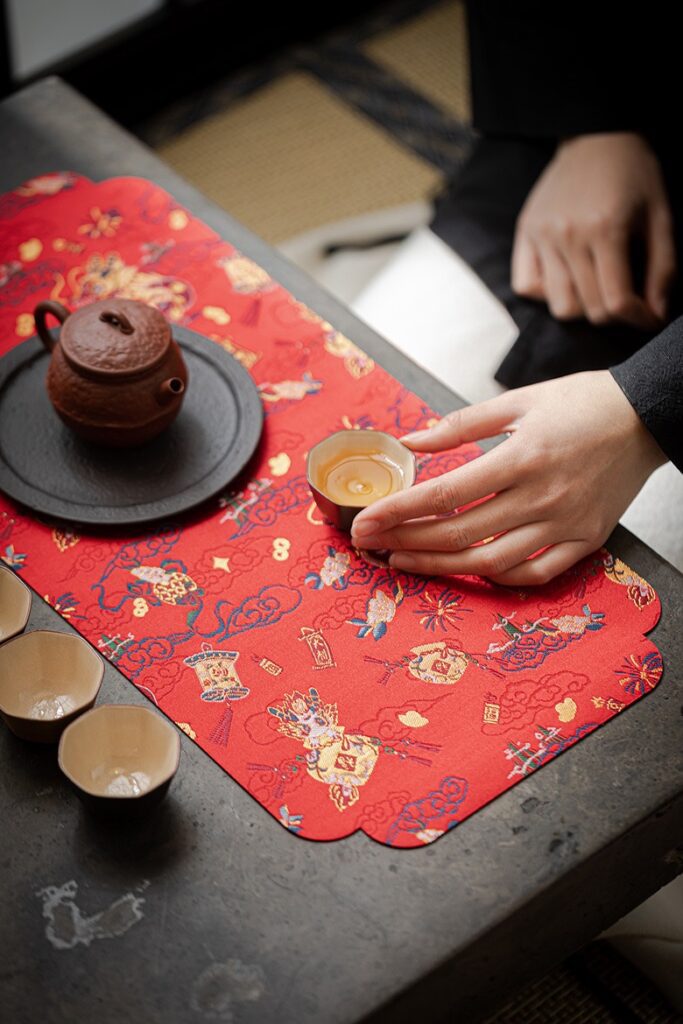
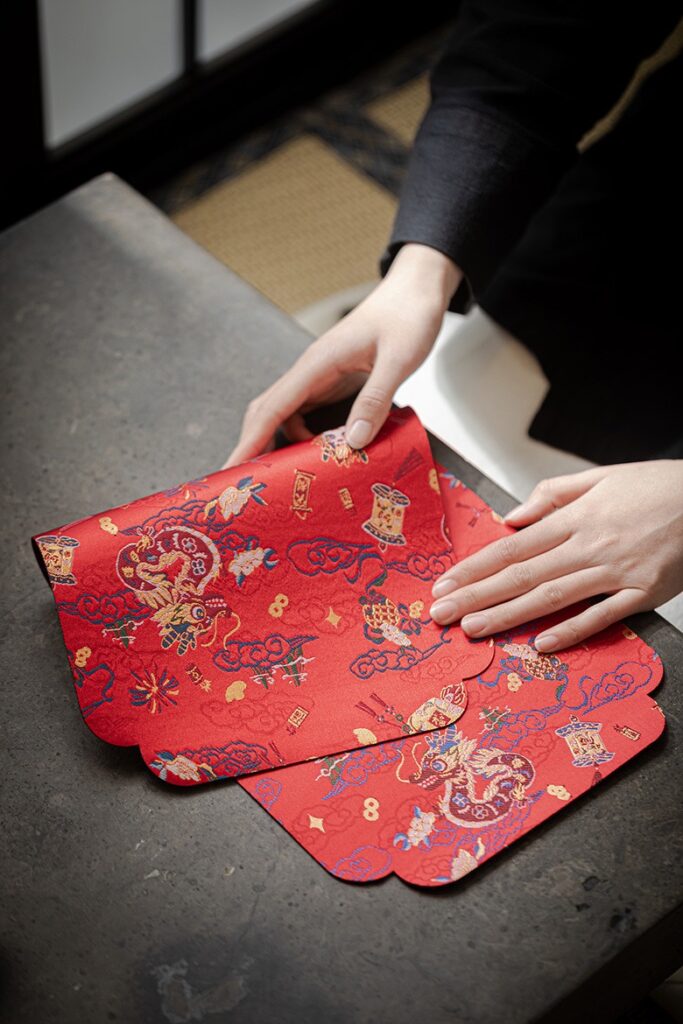
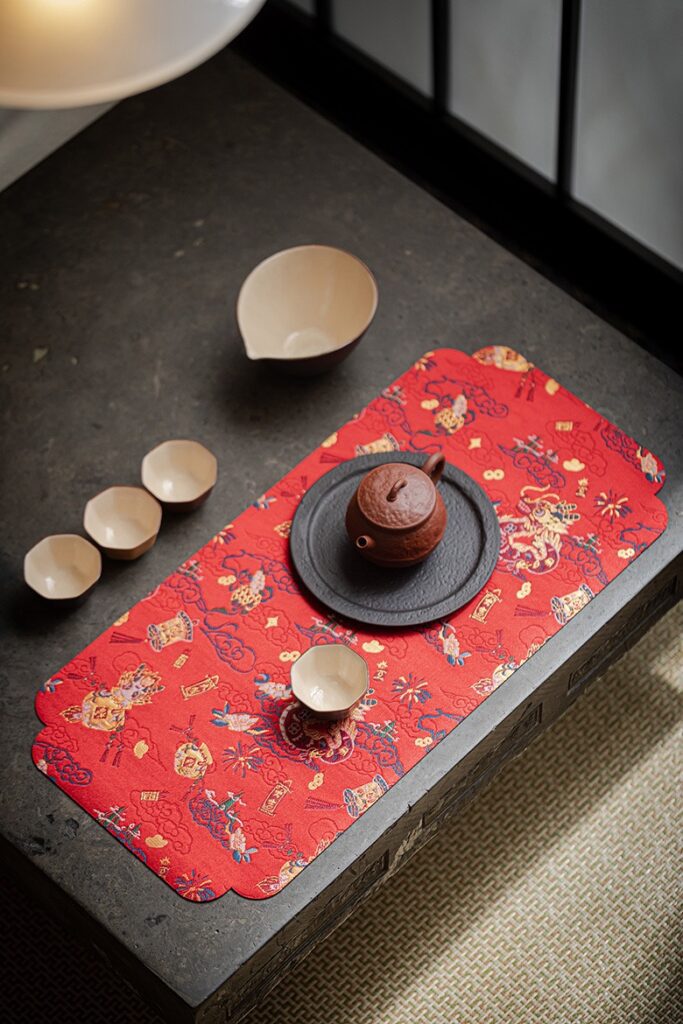
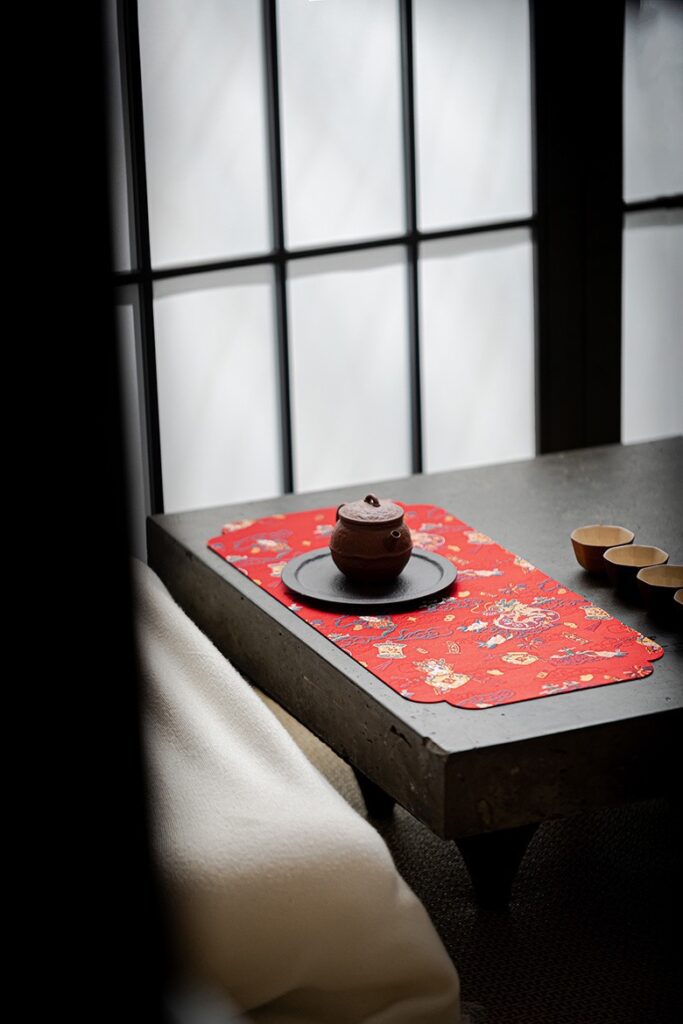
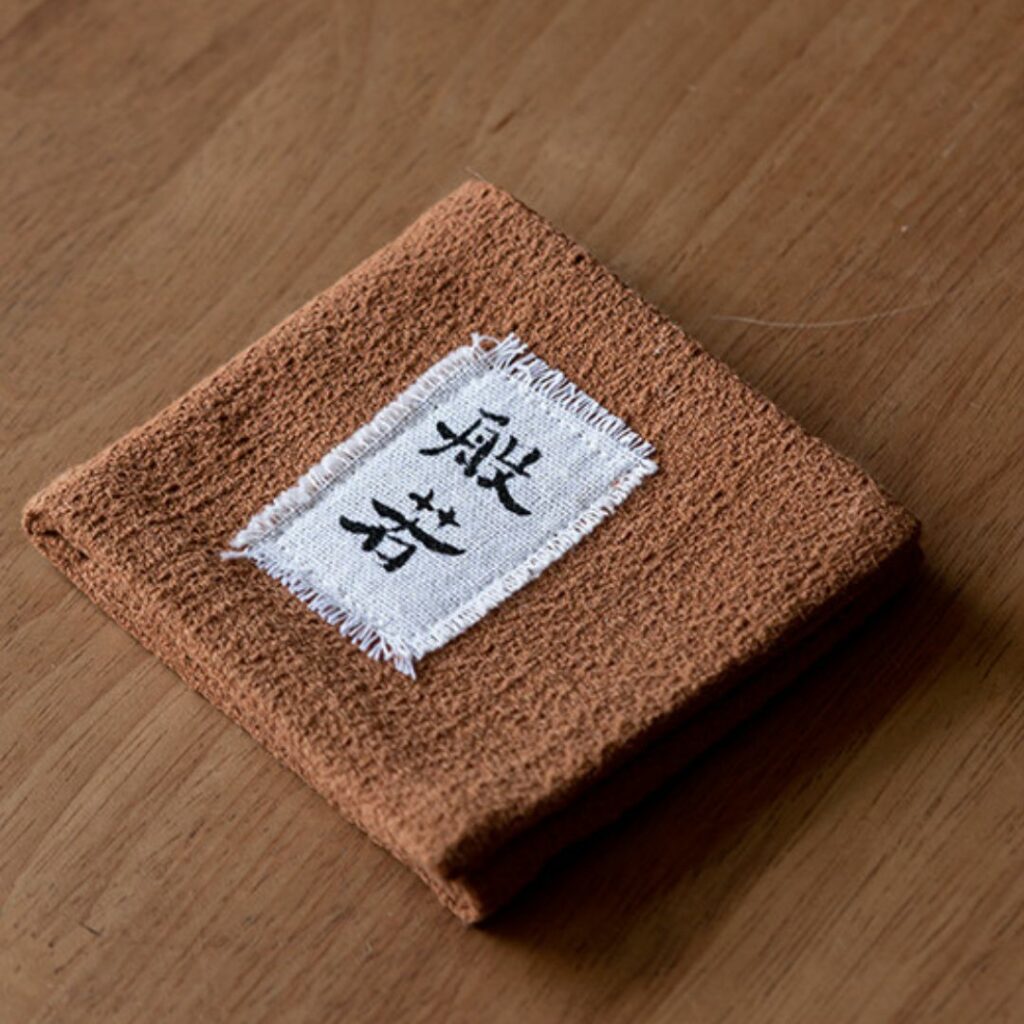
Hey tea lovers! 🐉✨ Exciting news as we step into the Dragon Year of 2024 - with Yixing teapot purchase, we're gifting you an exclusive Dragon Year style tea mat to add that extra flair to your tea rituals. It's our way of celebrating with you, but remember, it's a limited-time offer! Don't miss out on making your tea sessions even more special with this mystical addition. 🍵💫
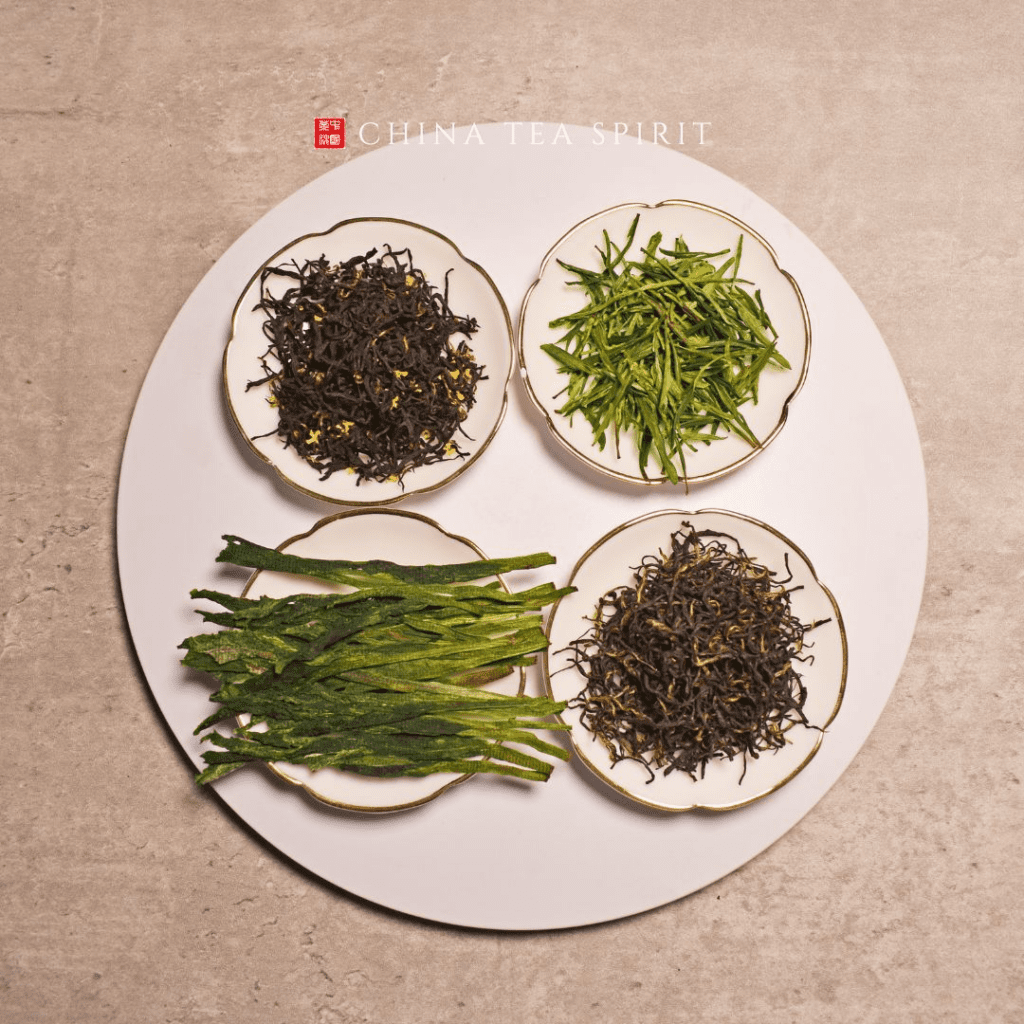
Hey tea lovers! While many of you know us as a premium Chinese tea wares company. We also specialized in teas in Huang Shan region. Huang Shan is home to the most famous Chinese teas – Huang Shan Mao Feng, Keemun and Tai Ping Hou Kui. As natives of this breathtaking place, we have a deep connection to the land and its rich tea heritage.
We understand that finding the perfect tea can be a personal journey, which is why we offer our sample pack. It allows you to explore the diverse flavors of Huang Shan teas and discover the one that resonates with your taste buds.
Each of the teas are sourced and produced directly from the tea farmers, ensuring the quality and the authentic taste.
Sample pack including: Huang Shan Mao Feng – 10g Tai Ping Hou Kui – 10g Keemun Mao Feng – 10g Osmanthus Keemun – 10g
We can’t wait to hear from your feedbacks on our teas. Join us on this journey and let us be your guide as you explore the enchanting world of Huang Shan teas.
Please note that the tea and tea wares will be shipped in seperate packages according to customs requirement. Usually tea will come slightly later than the tea wares.
Dear customers,
If you experienced any issues during checkout, please contact us at [email protected]. And we will help you out.
Below we listed common payment errors and their solutions for your reference.
#1: China Tea Spirit does not ship to this location. Please use a different address.
This is a known bug from PayPal. It occurs randomly. If you have seen this error message, please contact us at [email protected]. We will work this out for you.
Some Chinese mythical creatures are easy to recognize.
A dragon is unmistakable. A qilin, once you have seen a few, develops a recognizable silhouette. Pixiu appears often enough in ornaments and tea pets that many tea lovers eventually learn its name.
Suanni is harder to pin down.
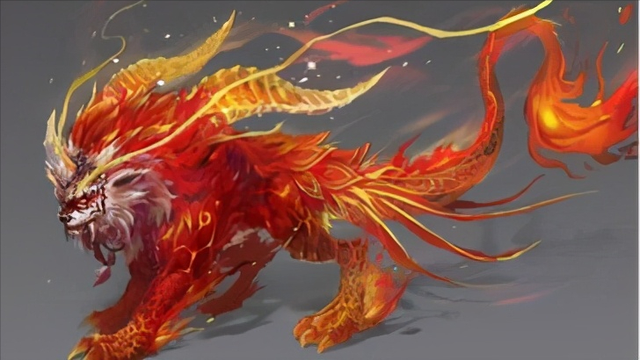
At first glance, it often looks like a lion—but not quite the lion you would see in a wildlife photograph. The mane may curl into decorative spirals. The face can feel almost dragon-like. Depending on the period, the material and the artist, Suanni may appear dignified, fierce, playful or strangely calm.
That uncertainty is part of what makes it interesting.
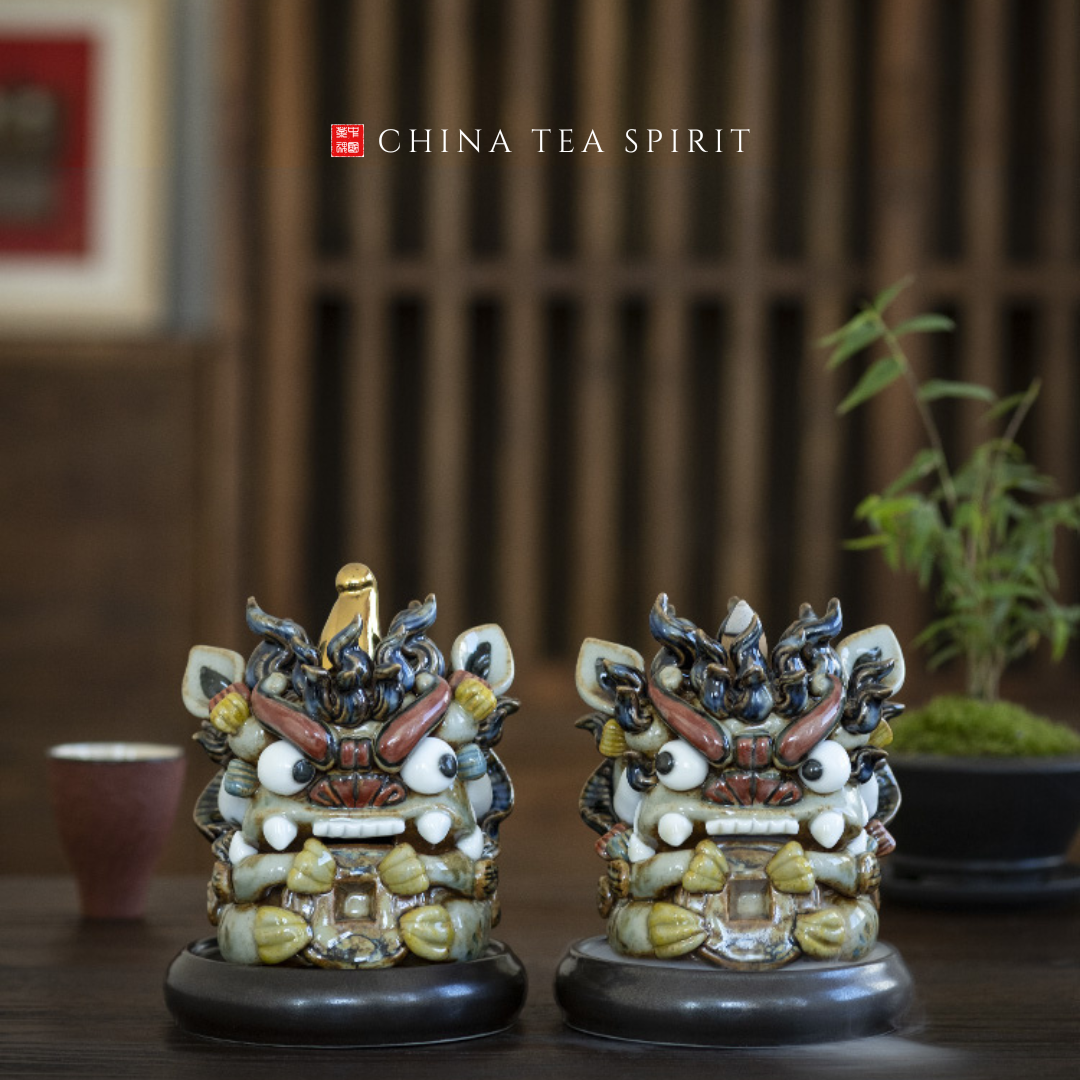
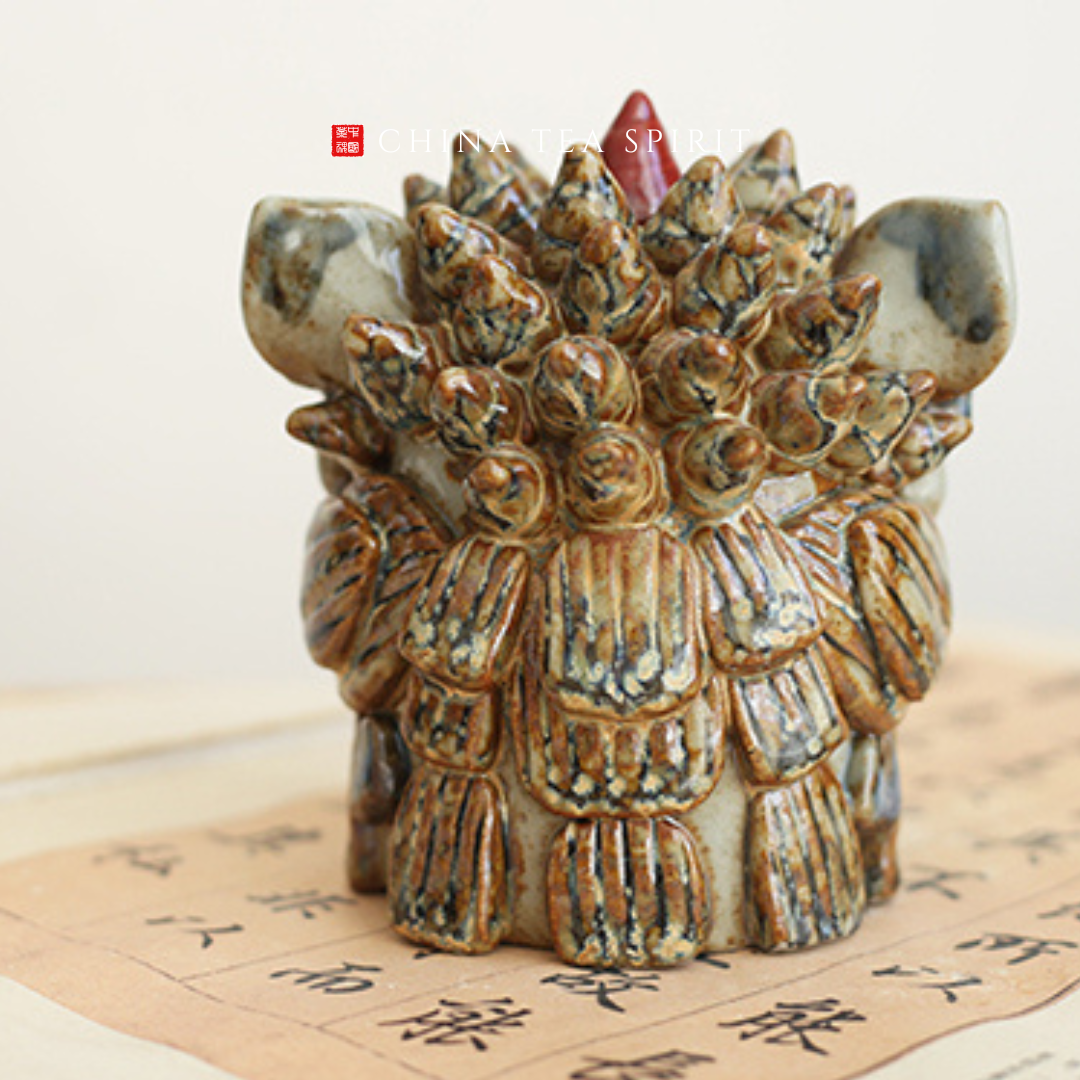
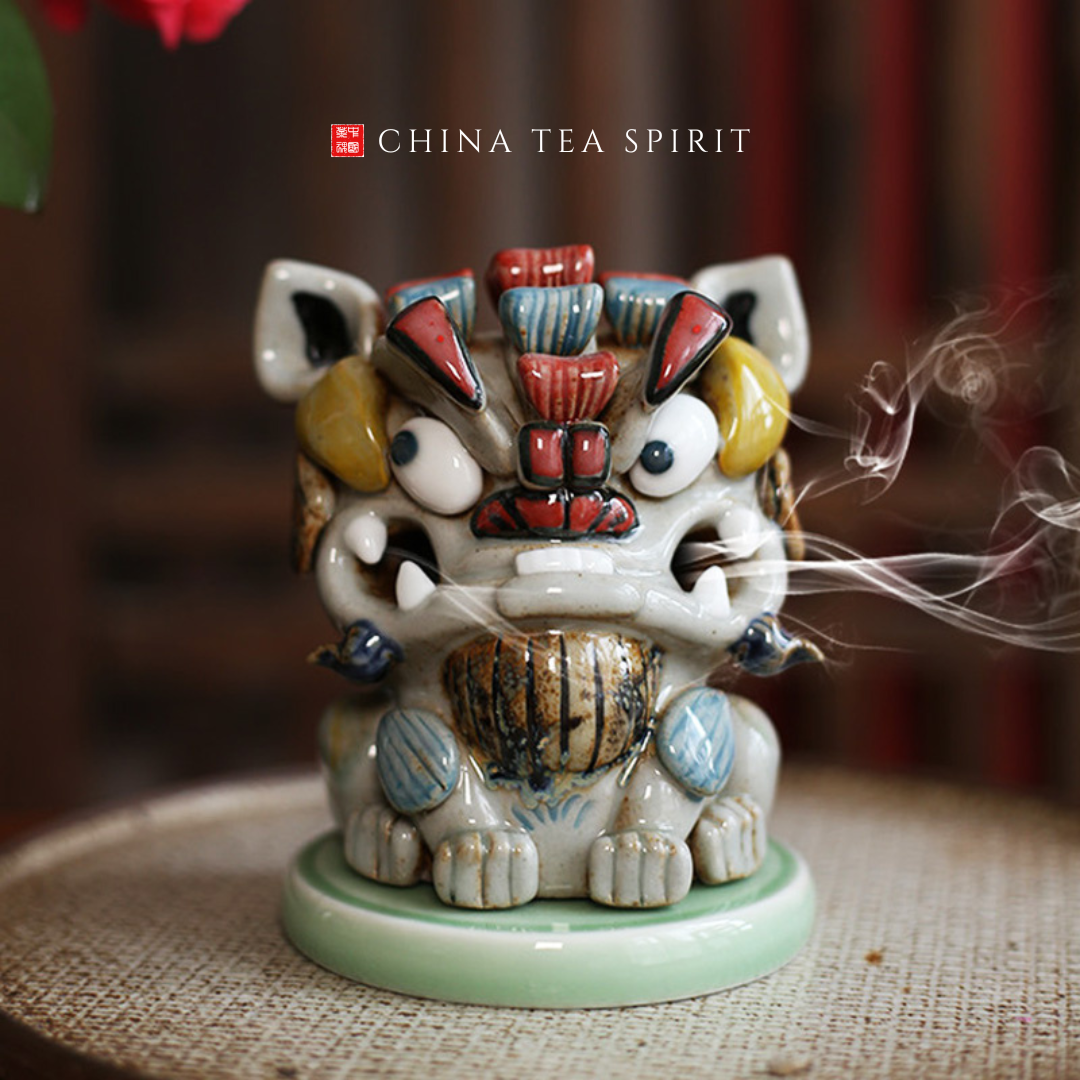
A contemporary ceramic interpretation of Suanni.
Suanni has been part of Chinese culture for a very long time, but the meaning attached to it did not remain fixed. Before it became widely known as one of the “Nine Sons of the Dragon,” the name was already associated with lion-like beasts.
Suanni was lion-like before it became a dragon son
The modern explanation usually starts with the Dragon.
Suanni, we are often told, is one of the Dragon’s sons. It has the appearance of a lion, enjoys sitting quietly, and later became associated with smoke and ceremonial objects.
That is a familiar and useful part of the tradition.
But the name is older than that story.
The National Museum of China describes Suanni as a beast that resembles a lion and notes that its image could vary considerably, appearing without horns, with one horn or with two. Another National Museum object also records the later tradition that places Suanni among the Dragon’s nine sons.
That changes the way the creature makes sense visually.
Suanni did not become lion-shaped simply because someone invented a lion-like child for the Dragon.
The lion connection came first.
Suanni has been imagined in different ways across Chinese decorative traditions.
A lion in Chinese art does not have to look realistic
Lions are not native to China.
Knowledge of them arrived through contact with regions to the west, and lion imagery gradually became deeply embedded in Chinese art. Buddhism also helped give the lion strong associations with dignity, strength and protection.
But Chinese artists were not trying to produce zoological studies.
They inherited forms from earlier sculptures, paintings, written descriptions and decorative conventions. Over time the lion became increasingly stylized: larger eyes, curled manes, compact powerful bodies and expressions that could be fierce or surprisingly playful.
Suanni developed inside this visual world.
That is why one anatomical rule—one kind of mane, horn or tail—is not enough to identify every Suanni. Its appearance has never been completely fixed.
Then Suanni joined the Dragon family
The familiar tradition of the Nine Sons of the Dragon became especially influential in later Chinese culture.
The idea fits decorative art beautifully: the Dragon has several sons, but each one is different. Their individual temperaments explain why they appear on different objects and architectural details.
One is associated with music. Another with carrying great weight. Another appears high on buildings.
Suanni becomes the lion-like one associated with sitting quietly.
There is an important detail that often disappears in simplified versions of the story: there was never one universally fixed historical list of the nine sons. The Palace Museum notes that even in the Ming dynasty the identities of the nine sons were not straightforward, and different traditions developed around them.
So it is better to think of the Nine Sons as an evolving cultural tradition than as one ancient mythology with an official cast of characters.
Suanni’s inclusion in that tradition nevertheless became very influential. An old lion-like creature now had a dragon lineage and a personality of its own.
What does Suanni symbolize?
It is tempting to reduce every Chinese mythical animal to one keyword.
Traditional imagery is usually more layered than that.
Because of its lion connection, Suanni naturally carries associations of strength, dignity and guardianship. It also came to be treated as an auspicious beast.
Its later mythology adds another quality: stillness.
Suanni is often imagined seated rather than rushing through the sky or fighting. That gives it a different mood from some of the more energetic mythical beasts.
It can look powerful without appearing aggressive.
Suanni, guardian lions, Qilin and Pixiu can be easy to confuse
This is where Chinese mythical creatures become difficult for anyone encountering them for the first time.
Several share the same visual vocabulary: lion-like faces, curled manes, claws, horns that appear in some versions and disappear in others, and dragon-like features mixed with ordinary animals.
Suanni is especially easy to confuse with Chinese guardian lions because both belong to a long tradition of stylized lion imagery.
But they are not exactly the same thing.
Guardian lions developed a very recognizable architectural role, particularly as paired protectors outside temples, palaces, gates and important buildings. Suanni belongs more directly to the world of mythical beasts and decorative imagery.
Likewise, Qilin and Pixiu developed their own traditions even though individual artworks can borrow similar features.
These distinctions help, but they are not biological classifications. Traditional artists had no reason to follow a modern character sheet.
Sometimes context tells you as much as anatomy.
So where does smoke enter the story?
This is the part that gave Suanni a particularly memorable role in later decorative culture.
Later versions of the Nine Sons tradition connect Suanni with quiet sitting and smoky surroundings. The Palace Museum’s popular explanation places the lion-like creature around Buddhist seats and incense burners, while the Prince Kung’s Palace Museum also records the later association between Suanni, fire and incense-burner decoration.
But it is better not to imagine that one myth appeared first and every artisan simply followed it afterward.
The relationship likely developed in both directions.
Lion-shaped incense burner, early 14th century, Jingdezhen Qingbai ware. The Metropolitan Museum of Art, Public Domain.
The Metropolitan Museum of Art preserves an early-14th-century Jingdezhen Qingbai porcelain incense burner in the shape of a lion. The image is public domain. Its sculptural body and open mouth show how naturally a lion form could become part of the burner itself.
A hollow animal-shaped burner needs openings for smoke to move through. Give it a lion-like body and an open mouth, and the creature appears to breathe.
Once this kind of object was associated with Suanni, the image gained a story: this was the creature that belonged around smoke.
The object reinforced the mythology. The mythology reinforced the object.
A contemporary Jingdezhen interpretation: the smoke completes the image by making the Suanni appear to breathe.
Why the form works so well
There is a particular pleasure in seeing smoke emerge from the mouth of a sculpted animal.
Without smoke, it is a ceramic creature.
With smoke, it becomes animated.
The open mouth is no longer only a sculptural detail. The hollow ceramic body is no longer only a container.
The function of the object completes the image.
This relationship between practical use and visual storytelling appears throughout Chinese craft. A motif becomes more meaningful because of the way the object is used.
With Suanni, smoke gives movement to something otherwise completely still.
An old image that never really disappeared
Suanni is still used in contemporary Chinese ceramics because the form remains visually strong.
Artists can make it solemn or playful, traditional or exaggerated, highly detailed or almost cartoon-like. The basic idea still survives: a powerful lion-like mythical beast with a long history in Chinese decorative culture.
At China Tea Spirit, we have contemporary Suanni ceramic pieces handmade in Jingdezhen by ceramic artist Xie Chenglong.
A paired contemporary Suanni composition handmade in Jingdezhen.
That continuity is what makes traditional imagery interesting.
It stays alive not by being frozen, but by being reinterpreted.
Suanni is difficult to define in one sentence—and that is a good thing
You can call it a lion-like mythical beast.
You can call it one of the later Nine Sons of the Dragon.
You can associate it with strength, dignity and guardianship.
You can recognize its later connection with smoke and incense.
All of those descriptions are useful.
None tells the entire story.
Suanni is interesting precisely because several layers of Chinese culture accumulated around the same creature. A lion-like beast entered Chinese imagination. Mythology gave it a new genealogy. Artists gave it new forms. Objects gave it new functions.
And centuries later, ceramic artists are still finding ways to reinterpret it.
So the next time you see a strange lion-like creature in Chinese ceramics, it is worth looking a little longer.
It may not simply be a lion.
It may be Suanni.
To meet the other creatures that appear across Chinese tea pets, ceramics and decorative objects, see our guide to Chinese mythical beasts.